SIM vs eSIM in Korea: Which Is Better for Travelers?
Last updated: September 2026
Staying connected in Korea makes almost every part of a trip easier.
You will probably use your phone for maps, subway directions, translation, restaurant searches, messaging, and reservations — often from the moment you leave the airport.
For most travelers, the main choice is between a physical SIM card and an eSIM.
Both can work well in Korea, but the better option depends on your phone, how much setup you want to do before arriving, and whether you need a Korean phone number.
Here is a simple way to decide.
Quick Answer: Should You Get a SIM or eSIM in Korea?
GOOD TO KNOW
For most travelers with an eSIM-compatible unlocked phone, an eSIM is usually the easiest option.
You can often purchase and install it before your trip, which means you can get connected soon after arriving in Korea without swapping a physical SIM card.
A physical SIM is still a good choice if your phone does not support eSIM, you prefer in-person setup, or you want help from staff at the airport.
My recommendation: Check your phone first. If it supports eSIM and is unlocked, start by comparing eSIM plans.
1. What Is the Difference Between a SIM and an eSIM?
A traditional SIM card is a small physical card that you insert into your phone.
An eSIM — short for embedded SIM — is built into compatible phones. Instead of inserting a card, you install a mobile plan digitally, usually by scanning a QR code or entering activation information.
Both can give you mobile data in Korea.
The biggest practical difference is how they are installed.
Physical SIM
- Inserted into your phone
- Often purchased online, at the airport, or at participating stores
- May require removing your home SIM
- Staff may be able to help with installation
eSIM
- Installed digitally
- No physical card to swap
- Often purchased before arriving
- Can be activated using a QR code
- Requires an eSIM-compatible device
KT and other carriers provide QR-based eSIM installation, and SK Telecom’s setup instructions note that an internet or Wi-Fi connection may be needed during activation.
2. SIM vs eSIM: Quick Comparison
Feature | Physical SIM | eSIM |
Installation | Insert SIM card | Digital setup |
Buy before trip | Often | Yes |
Airport pickup needed | Sometimes | Usually not |
Keep home SIM installed | Depends on phone | Often yes |
Phone compatibility | Most unlocked phones | eSIM-compatible phones only |
Korean phone number | Available on some plans | Available on some plans |
Best for | Travelers who prefer physical setup | Convenience and quick connection |
Neither option is automatically better. The best choice depends on your phone and the specific plan you purchase.
3. First, Check Whether Your Phone Is Unlocked
This is one of the most important things to check before buying either option.
Your phone needs to be carrier unlocked to use a Korean SIM or most travel eSIM plans.
A phone can support eSIM technology and still be locked to your home carrier.
Before your trip, check with your mobile carrier or your phone settings to confirm that the device can use another network.
Korea Byways Tip
Do this before you leave home.
Finding out at Incheon Airport that your phone is locked is much more inconvenient than checking a few days before your flight.
4. Does Your Phone Support eSIM?
Not every phone supports eSIM.
Many newer iPhones, Samsung Galaxy models, Google Pixel phones, and other recent smartphones do, but support can vary by:
- Model
- Country of purchase
- Carrier
- Device configuration
Do not rely only on the phone name.
For example, the same model family can sometimes have different eSIM capabilities depending on the market where it was sold.
The safest option is to check the manufacturer’s specifications for your exact model number.
5. Where Can You Buy a SIM Card in Korea?
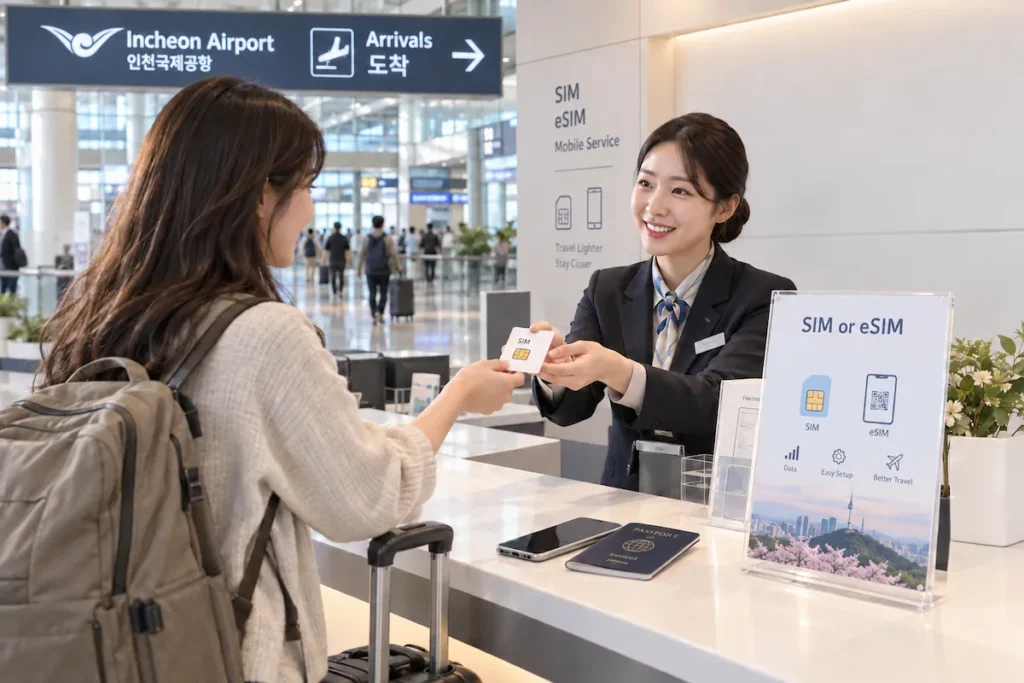
Travelers can purchase prepaid SIM cards at several places in Korea.
Common options include:
- Mobile carrier roaming centers at major airports
- Some airport convenience stores
- Participating convenience stores in cities
- Online before your trip
- Travel SIM providers
VisitKorea currently notes that traveler SIM cards are available at airports, convenience stores, and online, and recommends purchasing in advance or at the airport for convenience.
Korea Byways Tip
If you want someone to help you install and test the SIM before leaving the airport, buying from a carrier counter can be reassuring.
If you already know how to set up your phone, ordering in advance may save time after a long flight.
6. How Does an eSIM Work in Korea?
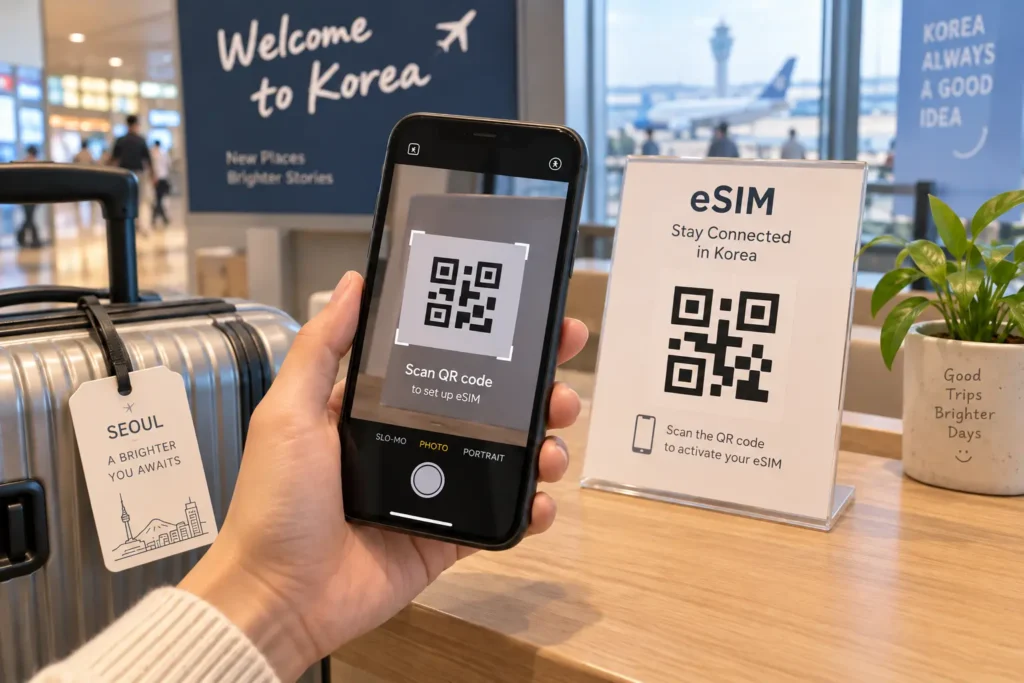
An eSIM can usually be purchased online.
After purchase, you typically receive:
- A QR code
- Installation instructions
- Plan information
You then add the eSIM through your phone’s mobile or cellular settings.
Some providers allow you to install the eSIM before your flight and begin using it once you arrive in Korea.
However, activation and validity rules differ by provider.
Some plans start when the eSIM first connects to a Korean network, while others may have different activation rules.
So always check:
When does the validity period begin?
before installing or activating your plan.
7. Should You Install Your eSIM Before Arriving in Korea?
Usually, yes — at least the installation part.
It can be easier to install the eSIM while you still have reliable home Wi-Fi.
Then, after arriving in Korea, you can switch mobile data to the Korean eSIM according to the provider’s instructions.
Important
Do not assume installation and activation mean the same thing.
Before setting it up, check whether your plan begins:
- When you install the eSIM
- When you activate it
- When it first connects to a Korean mobile network
This prevents accidentally starting a short-term plan too early.
8. Do You Get a Korean Phone Number?
This depends on the provider and the plan you choose.
Some eSIMs are data-only in function, while others include voice and SMS services. Whether you receive a Korean 010 phone number — and what you can do with it — depends on the specific provider and plan.
Before purchasing, check whether the plan includes:
- Mobile data only
- A Korean 010 phone number
- Incoming or outgoing calls
- SMS messages
- Any additional verification or activation requirements
For example, some visitor eSIM plans from Korean mobile carriers can provide a Korean 010 number, while voice and SMS availability may depend on the product and whether required identity or entry verification has been completed.
You can check the current options on the KT official eSIM page.
So before buying, do not look only at the amount of data. Check exactly whether a Korean phone number is included and which calling or messaging features are supported.
Do not assume that every “Korea eSIM” gives you the same type of Korean phone service.
9. Do You Actually Need a Korean Phone Number?
For many tourists, not necessarily.
If you mainly need your phone for:
- Naver Map
- KakaoMap
- Translation
- Messaging apps
- Browsing
- Social media
a data-only plan may be enough.
A Korean number can be useful if you want to:
- Receive local calls
- Receive certain SMS messages
- Give a Korean contact number to a hotel or reservation
- Contact local businesses more easily
However, having a Korean phone number does not automatically mean every Korean online identity-verification service will work.
Some Korean services require stronger identity verification connected to a resident account or specific mobile registration, so tourists should not buy a SIM solely expecting it to unlock every local app or website.
10. What About Food Delivery and Reservations?
This is where travelers often expect a Korean phone number to solve everything.
Unfortunately, it is not always that simple.
Some Korean services may require:
- A Korean phone number
- SMS verification
- Korean identity verification
- A Korean payment method
- A local account
A tourist SIM may help with receiving calls or SMS, but it does not guarantee access to every service.
So if food delivery is important to you, check the specific app requirements rather than choosing a SIM only because it includes a Korean number.
11. How Much Data Do You Need?
This depends on how you travel.
Light use
Maps, messaging, basic searches and email use relatively little data.
Moderate use
Add social media, frequent browsing, restaurant searches, and photo uploads.
Heavy use
Video streaming, video calls, hotspot use, large photo/video uploads, and constant social media can consume much more data.
Many visitor plans in Korea advertise high-data or unlimited options, but “unlimited” does not always mean unlimited full-speed data.
Some plans reduce your speed after a certain amount of high-speed usage.
So compare:
High-speed data allowance → reduced speed → hotspot/tethering rules
rather than looking only at the word “unlimited.”
12. Should You Buy Before Your Trip or at the Airport?
Both can work.
Buy before your trip if:
- Your phone supports eSIM
- You want to get online quickly after landing
- You are comfortable installing it yourself
- You want time to compare plans
Buy at the airport if:
- You prefer help from staff
- You want a physical SIM
- You are unsure about setup
- You want to confirm the service works before leaving
Major Korean carriers have airport roaming centers, and KT currently operates traveler service points at airports including Incheon.
13. Can You Keep Your Home SIM Active?
Often, yes — especially with an eSIM.
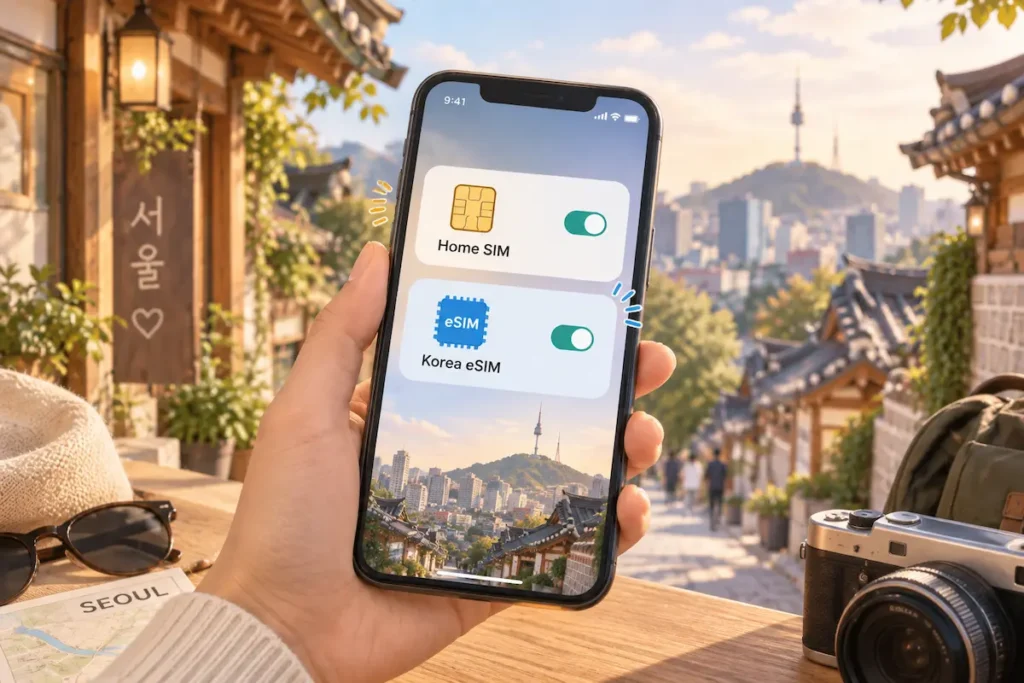
Many dual-SIM phones allow you to:
- Keep your home SIM installed
- Add a Korea eSIM
- Use the Korean eSIM for mobile data
- Keep your original number available for certain calls or messages
But be careful.
If your home SIM remains active, international roaming charges may still apply depending on your carrier and settings.
Before traveling, check:
- Mobile data line
- Data roaming
- Default voice line
- SMS settings
GOOD TO KNOW
Using a Korean eSIM for data does not automatically turn off roaming on your home SIM.
Check your settings before using mobile data in Korea.
14. What About Public Wi-Fi in Korea?
Korea has extensive public Wi-Fi.
VisitKorea notes that free Wi-Fi is available in many places including airports, subway stations, train stations, and some bus stops.
Hotels and cafés also commonly provide Wi-Fi.
But I would not rely on public Wi-Fi alone for a trip.
You may need internet while:
- Walking between destinations
- Waiting for a bus
- Searching for a restaurant
- Using translation
- Navigating in a smaller town
Having your own mobile data connection makes travel much easier.
15. What If You Are Traveling With Family or Friends?
You do not necessarily need an expensive unlimited plan for everyone.
Think about how each person uses their phone.
For example:
- One traveler may need heavy data
- Another may only use messaging and maps
- Children may use Wi-Fi most of the time
A pocket Wi-Fi router can also work for groups, but everyone needs to stay relatively close to the device.
For most independent travelers, individual SIMs or eSIMs are usually simpler because everyone can stay connected separately.
Common SIM & eSIM Mistakes to Avoid
Buying before checking compatibility
Confirm that your phone is unlocked and supports the SIM type you want.
Assuming every eSIM includes a Korean number
Many travel eSIMs are data-only.
Starting the plan too early
Check when the validity period begins.
Deleting an eSIM too soon
Do not remove the eSIM profile until you are sure you no longer need it. Reinstalling may not always be straightforward.
Forgetting about home-carrier roaming
Make sure your original SIM is not unintentionally using expensive roaming data.
Choosing a plan only because it says “unlimited”
Check the high-speed data allowance and reduced-speed policy.
SIM vs eSIM: Which Should You Choose?
Choose an eSIM if:
- Your phone supports eSIM
- Your device is unlocked
- You want to prepare before your trip
- You do not want to swap physical SIM cards
- Convenience is your priority
Choose a physical SIM if:
- Your phone does not support eSIM
- You prefer in-person setup
- You want assistance at the airport
- You are more comfortable using a physical SIM
Consider a plan with a Korean number if:
- You expect to make or receive local calls
- You want SMS capability
- Your accommodation or reservations may need a local contact number
But remember:
A Korean phone number does not guarantee access to every Korean verification-based service.
What I Recommend for a First Trip to Korea
For most travelers, I would keep it simple:
1. Check whether your phone is unlocked.
2. Check whether it supports eSIM.
3. Decide whether you need a Korean phone number or only data.
4. Compare the data allowance and validity period.
5. Check exactly when the plan activates.
6. Install an eSIM before departure if the provider allows it.
7. Keep your home SIM’s roaming settings under control.
8. Test your Korean connection after arrival.
If your phone supports eSIM and you mainly need data for maps, messaging, and travel apps, an eSIM is often the easiest choice.
If not, a physical SIM purchased at the airport is still a simple and reliable option.
Final Thoughts
There is no single best SIM option for every traveler.
For many visitors, an eSIM offers the easiest setup and lets you arrive in Korea ready to connect. A physical SIM remains a good option for travelers who prefer help in person or whose phones do not support eSIM.
The most important thing is to check your phone compatibility and understand exactly what your plan includes before you buy.
Once your mobile connection is ready, the next practical question is how to pay while traveling in Korea.
Share this guide
NEXT GUIDE
TRAVEL ESSENTIALS