How to Pay in Korea: Cash, Cards & Mobile Payments for Travelers
Last updated: September 2026
Paying for things in Korea is usually easier than many first-time visitors expect.
Credit and debit cards are widely accepted at hotels, restaurants, cafés, convenience stores, department stores, and many other businesses.
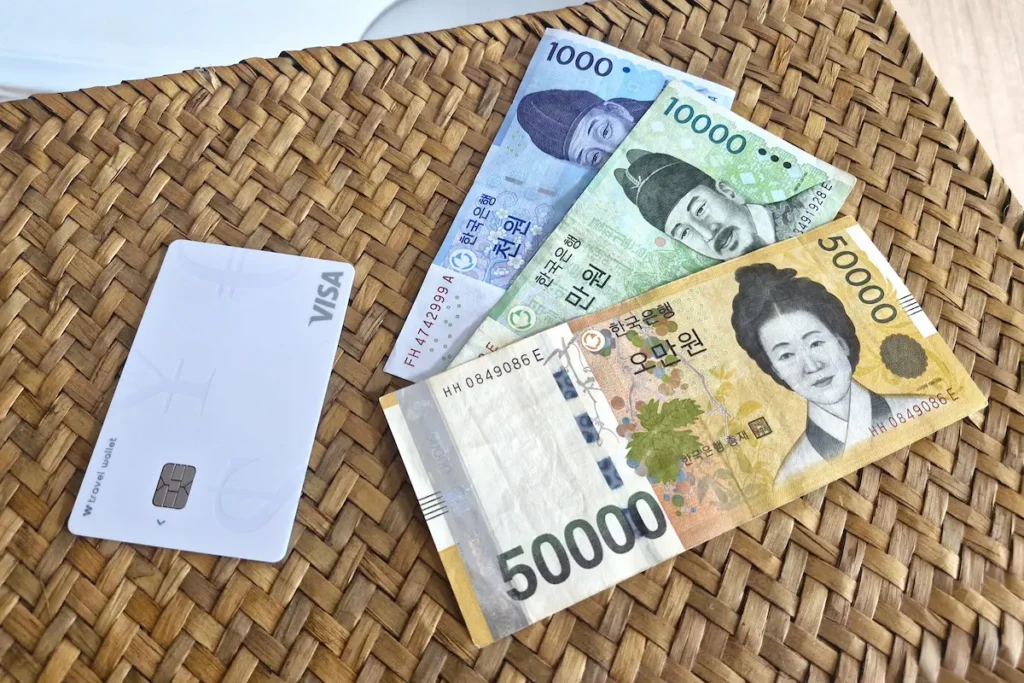
However, that does not mean you should arrive with no Korean won at all.
Cash can still be useful for transportation-card top-ups, some traditional markets, smaller businesses, and situations where an international card does not work.
Here is a simple guide to paying in Korea without carrying more cash than you need.
Quick Answer: Do You Need Cash in Korea?
GOOD TO KNOW
For most travelers, one or two international payment cards plus a small amount of Korean won is the easiest setup.
Cards are widely accepted throughout Korea, including at most hotels, restaurants, cafés, convenience stores, and shops.
But keeping some cash is useful for transportation-card top-ups and the occasional small business or market stall that may not accept your card.
My recommendation: Use a card for most everyday purchases, but keep about ₩50,000–100,000 in cash as a backup rather than carrying a large amount.

1. What Currency Is Used in Korea?
South Korea uses the Korean won, written as:
₩
or
KRW
Common banknotes include:
- ₩1,000
- ₩5,000
- ₩10,000
- ₩50,000
Coins include ₩10, ₩50, ₩100, and ₩500.
VisitKorea identifies the won as Korea’s official currency and provides current information on credit-card use and authorized currency-exchange locations.
2. Can You Use Foreign Credit Cards in Korea?
Yes, in most situations.
Visa, Mastercard, American Express, and other major international cards are widely accepted in Korea.
You can usually pay by card at:
- Hotels
- Department stores
- Restaurants
- Cafés
- Convenience stores
- Supermarkets
- Tourist attractions
- Many taxis
- Major train and transportation ticket counters
VisitKorea states that most businesses in Korea accept credit cards and specifically lists major international card networks including Visa, Mastercard, American Express, JCB, and UnionPay.
Korea Byways Tip
Bring at least two cards from different accounts or networks if possible.
Even if a card works everywhere else on your trip, an individual terminal or overseas transaction may occasionally fail.
A backup card prevents a small payment problem from becoming a travel problem.
3. Do You Still Need Cash?
A little.
You do not need to carry enough cash for your entire trip, but I would not travel around Korea completely cash-free.
Cash can still be useful for:
- Recharging a regular T-money card
- Some traditional market stalls
- Small local businesses
- Coin lockers or older machines
- Emergency backup if a foreign card is declined
This is especially useful if you travel beyond Seoul into smaller towns, which is something many Korea Byways readers may do.
4. How Much Cash Should You Carry?
There is no exact amount that every traveler needs.
For a typical short trip, I would start with:
₩50,000–100,000 per person
and use a credit or debit card for most larger purchases.
You can always withdraw or exchange more later if necessary.
Carrying a smaller amount also means you will have less leftover Korean won at the end of your trip.
5. Where Should You Exchange Money?
If you bring foreign cash, use:
- Banks
- Authorized currency exchange centers
- Airport exchange counters
VisitKorea recommends banks or authorized exchange centers for exchanging foreign currency. Banks are generally open during weekday business hours, although schedules can vary.
Airport exchange counters are convenient immediately after arrival, although exchange rates may differ from those available elsewhere.
Korea Byways Tip
You do not need to exchange your entire travel budget at the airport.
Exchange or withdraw enough to get started, then use cards for most everyday spending.
6. What About ATMs?
International travelers can often withdraw Korean won using compatible foreign debit or credit cards at ATMs that support international networks.
Before traveling, check:
- Whether your card allows overseas withdrawals
- Your bank’s foreign ATM fee
- Your daily withdrawal limit
- Whether a travel notification is required
ATM operators or your home bank may also charge fees.
Because compatibility can vary by card and ATM, having more than one way to access money is useful.
7. Can You Tap a Foreign Credit Card on the Subway or Bus?
Usually, do not assume you can.
This is an important distinction.
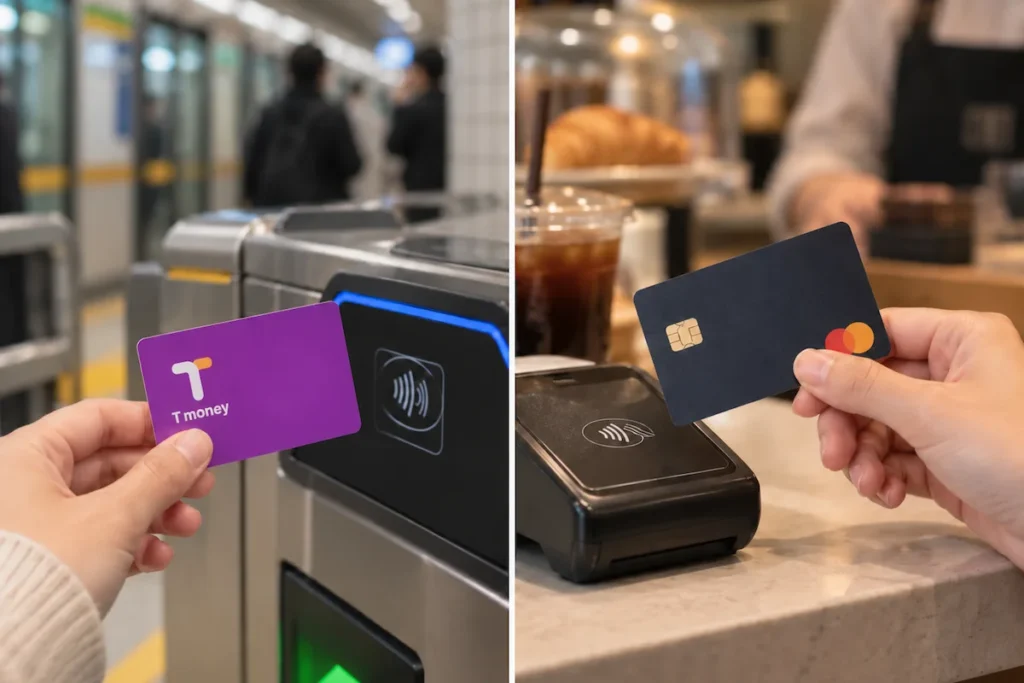
You may be able to use your foreign credit card to buy certain transportation tickets, but that does not mean you can tap the same foreign card directly at every subway gate or bus reader.
Korea Tourism Organization’s 2026 transportation guide states that foreign-issued credit cards are accepted at a growing number of transportation ticket machines and counters, but regular subway and bus travel generally still relies on a transportation card such as T-money.
So for ordinary public transportation:
Use your T-money card.
For ticket purchases at major rail stations or compatible machines:
Foreign credit cards may be accepted.
This is why a payment card and a transportation card serve different purposes in Korea.
8. Can You Buy or Recharge T-money With a Foreign Card?
For a regular T-money card, do not rely on your international card for top-ups.
The 2026 Korea Tourism Organization transportation guide states that foreign-issued credit cards are not accepted for purchasing or topping up a regular T-money card and identifies cash as the standard option.
That is one of the main reasons I recommend carrying a small amount of Korean won.
GOOD TO KNOW
Keep some cash specifically for transportation-card top-ups.
Even if you use a credit card for almost everything else, your T-money balance can run low at an inconvenient time.
9. How Do You Pay at Restaurants and Cafés?
At most restaurants and cafés, paying is straightforward.
In many Korean restaurants, you pay at the counter near the entrance rather than waiting for a server to bring the bill to your table.
Usually you can simply hand over your card or use the payment terminal.
Some restaurants use:
- Self-service kiosks
- Table-order tablets
- Counter payment
- QR or mobile ordering systems
If an automated machine does not accept your foreign card, ask the staff whether you can pay at the counter.
10. How Do You Pay at Convenience Stores?
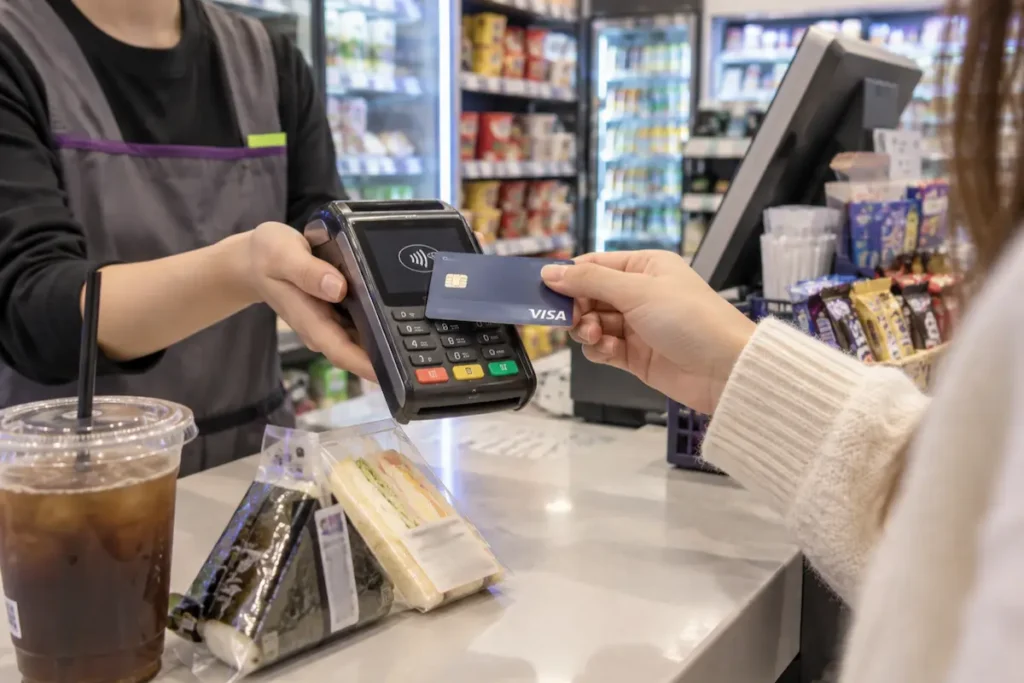
Convenience stores are among the easiest places for travelers to pay.
Major chains commonly accept international credit cards.
You can also use participating prepaid or transportation cards for some purchases.
VisitKorea notes that T-money and other prepaid cards can be used at affiliated shops displaying the relevant logo.
For most travelers, however, a regular international card is usually simpler for convenience-store purchases.
11. What About Traditional Markets?
Traditional markets vary.
Some larger or tourist-oriented stalls accept cards or QR payments, while smaller vendors may prefer cash.
For that reason, I would bring Korean won when visiting a traditional market even if you expect to use your card most of the time.
You do not need a large amount.
A few ₩10,000 notes can be very useful.
12. Can You Use Mobile Payments in Korea?
Yes, but compatibility depends on the payment service and merchant.
Korea has extensive domestic mobile-payment and QR-payment systems, but not every international mobile wallet works at every Korean merchant.
Some overseas payment apps can be used through participating QR networks. VisitKorea has highlighted international mobile-payment services that can be used at participating ZeroPay merchants.
For a short visit, I would treat mobile payment as a useful extra, not your only payment method.
My recommendation
Bring a physical international card even if you normally pay only with your phone at home.
That gives you a backup if your preferred mobile wallet is not supported.
13. What About Apple Pay and Other Digital Wallets?
Digital wallet acceptance continues to expand, but support depends on the merchant, terminal, card issuer, and wallet.
For example, VisitKorea reported that Apple Pay is accepted at some KORAIL ticket counters, but that does not mean every store or transportation reader in Korea accepts it.
So do not arrive expecting your phone wallet to replace every physical card.
Think of it as:
Mobile wallet = convenient option
Physical card = reliable backup
14. Can You Pay for Taxis With a Foreign Card?
Many taxis have card-payment terminals, and foreign-issued cards are commonly accepted.
The 2026 Korea Tourism Organization transportation guide lists foreign-issued credit-card payment as available for taxi card readers.
Taxi apps may also support foreign cards, depending on the service.
Still, having a small amount of cash is useful in case a terminal or app payment does not work.
15. What About Online Reservations?
This can be more complicated than paying in person.
Some Korean websites and apps accept international cards, while others may require:
- A Korean-issued card
- A Korean phone number
- Local identity verification
- A domestic account
This is especially relevant for certain reservations, delivery services, and local platforms.
If an official Korean website does not accept your card, check whether the same service is available through an international booking platform.
As explained in the SIM vs eSIM guide, having a Korean phone number does not automatically mean every local payment or identity-verification system will work.
16. Should You Choose KRW or Your Home Currency?
Sometimes a payment terminal may offer you a choice between paying in:
KRW
or
your home currency.
This is known as currency conversion at the point of sale.
In general, I prefer paying in KRW and allowing my own card issuer to handle the exchange rate.
If you choose your home currency, check the displayed exchange rate and fees carefully before confirming.
Your card issuer may also charge a foreign-transaction fee, depending on your card.
17. Can Tourists Get Tax Refunds?
Some purchases by eligible international visitors may qualify for VAT refunds.
Participating stores may offer immediate tax refunds, while other purchases may require processing through a refund counter or kiosk.
VisitKorea provides a dedicated guide explaining tax-refund procedures and notes that refunds may be returned to methods including international credit cards, depending on the process used.
If tax-free shopping matters to you:
- Look for tax-refund signage
- Keep your receipt
- Carry your passport when required
- Confirm the procedure before leaving the store or airport
18. Should You Get a Tourist Prepaid Payment Card?
You may see traveler-focused prepaid cards such as:
- WOWPASS
- Trip.PASS
- Other travel/payment cards
These can combine features such as card payments, currency exchange, transportation, or tourist services.
VisitKorea lists prepaid cards including T-money and WOWPASS as payment options at participating stores and has also covered newer tourist-oriented payment products.
You do not need one simply to travel in Korea.
If your international credit card works well, a prepaid travel card is optional.
It may be useful if:
- You prefer to control your spending in advance
- Your home card charges high overseas fees
- You want one travel-specific payment card
- You want additional tourist features
Common Payment Mistakes to Avoid
Arriving with only one card
Bring a backup payment method.
Carrying no Korean cash at all
Keep enough for T-money top-ups and small cash-only situations.
Assuming a foreign card can be tapped directly on every bus or subway gate
Use a transportation card for normal public transit.
Relying only on a mobile wallet
Bring a physical card as backup.
Exchanging too much cash at once
Start with a modest amount and get more only if needed.
Assuming every Korean website accepts foreign cards
Online payment rules can differ from in-person payments.
What I Recommend for a First Trip to Korea
For most travelers, I would keep the setup simple:
1. Bring two international credit or debit cards if possible.
2. Keep around ₩50,000–100,000 in Korean won as backup.
3. Use a card for most restaurants, cafés, hotels, shops, and convenience stores.
4. Use T-money for normal buses and subways.
5. Keep cash available for T-money top-ups.
6. Bring a physical card even if you normally use a mobile wallet.
7. Check your card’s foreign-transaction and ATM fees before traveling.
8. Keep one backup card somewhere separate from your main wallet.
That covers most situations without carrying a large amount of cash.
Final Thoughts
Paying in Korea is generally easy for international travelers.
Major credit cards are widely accepted, so you do not need to carry large amounts of Korean won for everyday travel.
But a small cash backup is still useful — especially for transportation cards, traditional markets, and the occasional situation where an international card does not work.
For a first trip, the simplest setup is:
International card + backup card + T-money + a small amount of cash.
Once your payment setup is ready, the next practical thing to understand is how taxis work in Korea.
Share this guide
NEXT GUIDE
TRAVEL ESSENTIALS