How to Use Korean Convenience Stores: A First-Timer’s Guide
Korean convenience stores are everywhere.
You will see them near subway stations, hotels, apartment buildings, and even on quiet neighborhood streets.
For travelers, they are much more than places to buy bottled water.
You can pick up breakfast, snacks, ready-to-eat meals, transportation cards, toiletries, and plenty of things you may suddenly realize you need during a trip.
Most of the time, using a Korean convenience store is very easy.
But a few things — especially 1+1 promotions, bags, transportation cards, and in-store facilities — may not be obvious on your first visit.
Here is what I would want to know before walking into one for the first time.
Quick Answer: Are Korean Convenience Stores Easy for Tourists to Use?
GOOD TO KNOW
Yes. Korean convenience stores are generally very easy to use, even if you do not speak Korean.
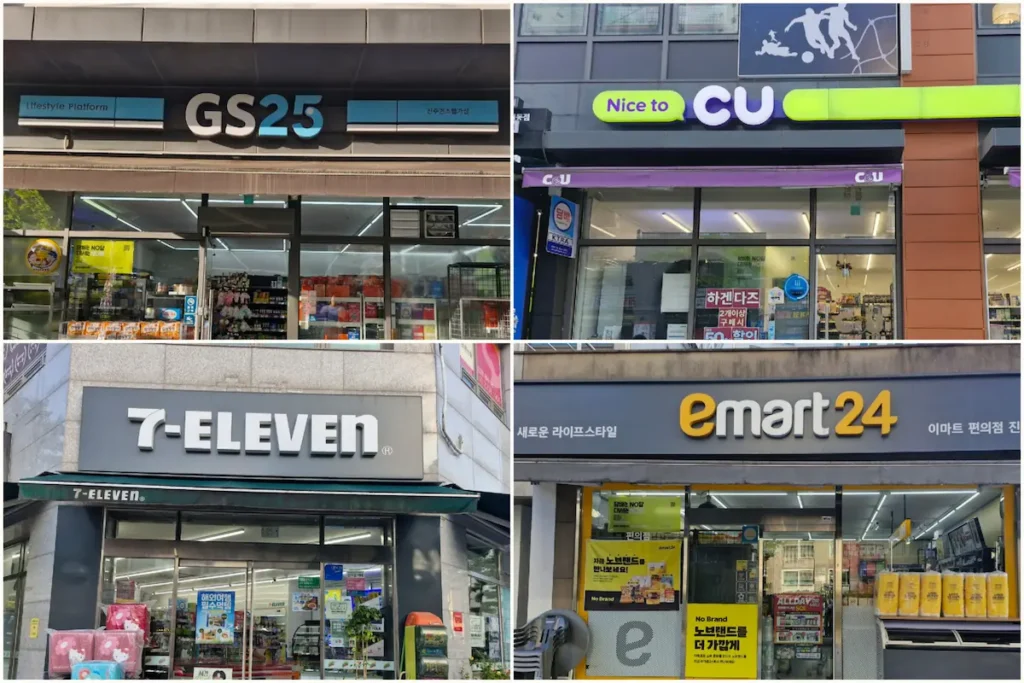
Major chains include:
- CU
- GS25
- 7-Eleven
- emart24
You choose what you want, take it to the counter, and pay much as you would anywhere else.
The main things worth knowing are:
- 1+1 and 2+1 promotion signs
- whether you need a shopping bag
- how transportation-card purchases and top-ups work
- whether the branch has seating, a microwave, or hot water
- how to prepare convenience-store food
The last part can be surprisingly confusing, so I cover it separately in my food guide.
My recommendation: On your first visit, do not worry about finding the “best” convenience-store chain. Go into whichever one is nearby and get familiar with how things work.
1. Which Convenience Stores Will You See in Korea?
The four names you are most likely to notice are CU, GS25, 7-Eleven, and emart24.
For a traveler, there is no need to search for one particular chain.
They all sell the basics:
- Drinks
- Snacks
- Instant noodles
- Ready-to-eat meals
- Coffee
- Ice cream
- Toiletries
- Small everyday essentials
What can vary quite a lot is the individual branch.
A large convenience store near a university or office district may have several tables and a large food section.
A tiny neighborhood branch may have no seating at all.
So I would think less about the brand and more about the store in front of you.
2. How Do You Pay?
The basic process is simple.
Take your items to the counter and place them in front of the cashier.
Some larger stores also have self-checkout machines, but there is no need to use one if you are unsure.
Cards are commonly used in Korea, and many travelers will be able to pay with an international credit or debit card.
Still, I would keep a small amount of Korean won as a backup.
A foreign-issued card can occasionally fail even when the same card has worked elsewhere.
You may also be asked whether you need a bag.
A useful phrase is:
봉투 주세요.
Bongtu juseyo.
A bag, please.
Do not automatically expect a free shopping bag. Depending on the store and bag type, there may be a small charge.
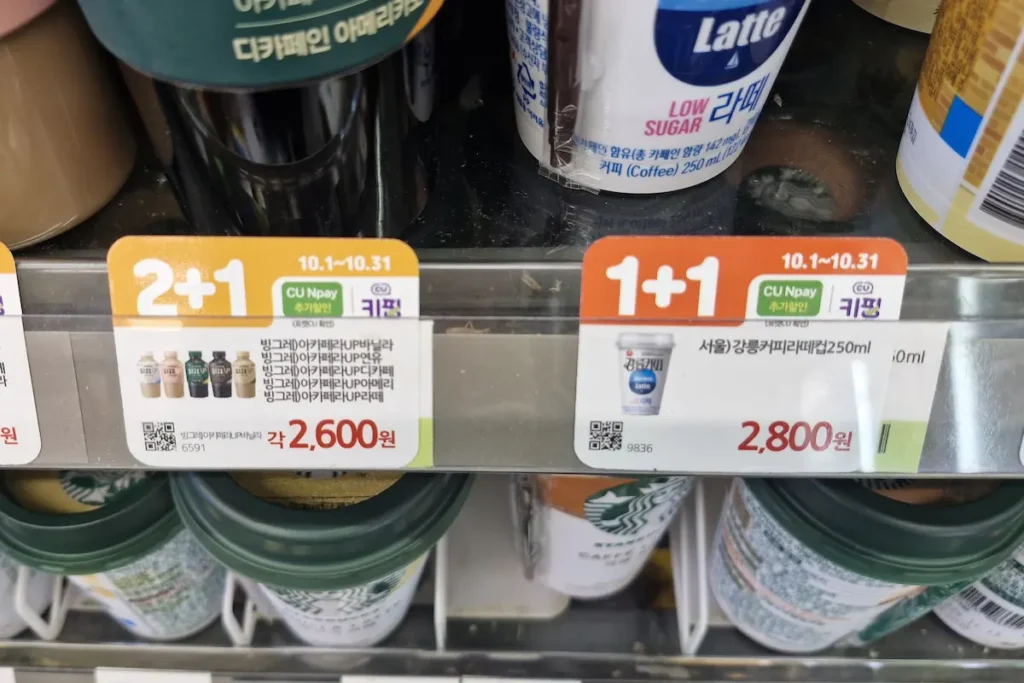
3. What Do 1+1 and 2+1 Mean?
This is one of the first things I would learn.
You’ll see these promotions frequently at convenience stores in Korea.
1+1
Buy one eligible item and get one more as part of the promotion.
2+1
Buy two eligible items and get one more.
The important part is this:
You normally need to take all of the promotional items to the checkout yourself.
If a drink has a 1+1 label and you bring only one bottle, do not assume the cashier will automatically give you another one.
Also check the promotional label carefully.
Sometimes you need the exact same product. Other promotions may include several products in the same group.
Korea Byways Tip
If you are unsure whether two products belong to the same promotion, take both to the counter and show the label.
Pointing works surprisingly well.
You do not need perfect Korean to shop at a convenience store.
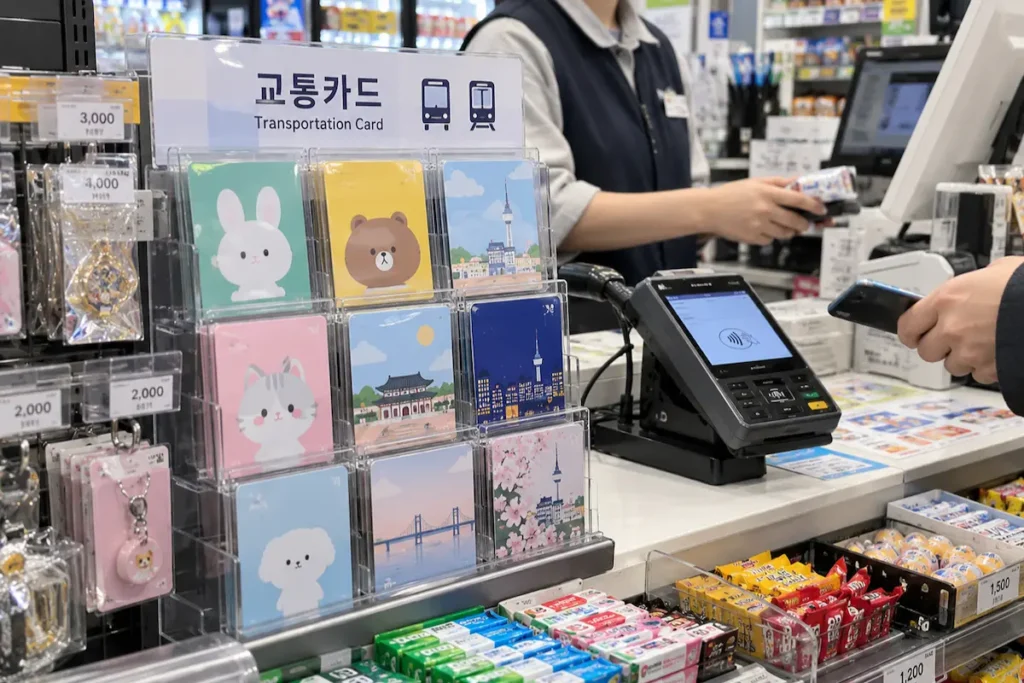
4. Can You Buy or Recharge a Transportation Card?
Often, yes.
Many convenience stores sell transportation cards such as Tmoney and other locally used transit cards.
You may also be able to add money to an existing card at the counter.
If you want to recharge your card, you can show it to the cashier and say:
교통카드 충전해주세요.
Gyotong kadeu chungjeon haejuseyo.
Please top up my transportation card.
Exact card availability and payment methods can vary by store, so if one branch cannot help you, another convenience store or a subway station may be easier.
5. Can You Eat Inside a Korean Convenience Store?
Sometimes.
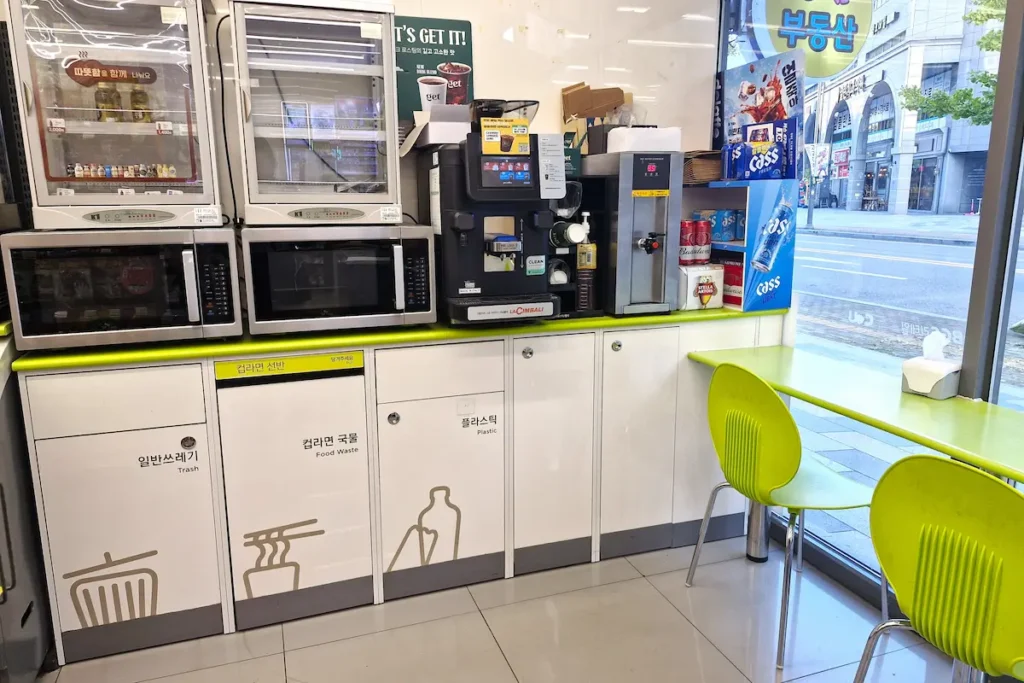
Some branches have:
- Tables
- Counter seating
- Outdoor seats
- Microwaves
- Hot-water dispensers
Others have almost none of these.
If there is a clearly designated eating area, you can usually sit down and eat what you bought.
Just clean up after yourself and follow the store’s rubbish-disposal system.
One thing I would not assume is that every convenience store has a customer restroom.
Some do.
Many do not.
If you need one, it is better to ask rather than walking around the store looking for it.
Facilities vary a lot by branch, even within the same chain. If you plan to sit down or prepare a meal, take a quick look around before buying everything.
6. What About Microwaves and Hot Water?
This is where Korean convenience stores start becoming a little more interesting.
Many stores have equipment customers can use to prepare food.
You may see:
- Microwaves
- Hot-water dispensers
- Instant-noodle preparation areas
- Ice-cup drink sections
- Chopsticks and spoons
But if it is your first time, it is not always obvious what you are supposed to do.
Some foods need to be microwaved.
Others should not.
Cup noodles need hot water.
Ice-cup drinks have their own little system.
And even something as simple as finding disposable chopsticks may take a moment if you do not know where to look.
I explain all of that step by step in:
How to Eat at a Korean Convenience Store: Ramyeon, Microwaves, Ice Cups & More
7. Common First-Time Mistakes to Avoid
Taking only one item from a 1+1 promotion
Take both eligible items to the checkout.
Assuming every store has seating
Check before buying food you plan to eat immediately.
Opening food before paying
Pay first.
Then prepare or eat it.
Expecting every foreign card to work
Most of the time you should be fine, but having a little cash or another card is useful.
Assuming every convenience store has a restroom
Do not count on it.
Throwing everything into the same bin
Convenience stores may separate general waste, recyclables, and food or liquid waste.
Look at the signs before throwing things away.
8. A Few Useful Korean Phrases
You can get through most convenience-store visits without saying much at all.
But these are useful:
봉투 주세요.
Bongtu juseyo.
A bag, please.
교통카드 충전해주세요.
Gyotong kadeu chungjeon haejuseyo.
Please top up my transportation card.
이거 원플러스원이에요?
Igeo won-peulleoseu-wonieyo?
Is this 1+1?
And if none of that comes to mind, pointing at the product or price label is perfectly fine.
9. What I Recommend for Your First Visit
Keep it simple.
On your first visit:
1. Pick up a drink or snack.
2. Look for a 1+1 or 2+1 label.
3. Notice where the microwave and hot water are.
4. Check whether the store has a seating area.
5. Pay at the counter.
6. Notice where customers prepare food and dispose of waste.
You will understand the basic system very quickly.
After that, Korean convenience stores become much more fun.
You can start trying cup noodles, ready-to-eat meals, ice-cup drinks, and the food combinations Koreans make from several different products.
That is the part I enjoy most.
Final Thoughts
A Korean convenience store is one of those places that seems completely ordinary once you live here.
But for travelers, it can be a surprisingly useful introduction to everyday Korea.
It is where you see what people grab for breakfast, which drinks are on promotion, what new snacks have appeared, and how much can be packed into a very small store.
You do not need to understand everything before your first visit.
Learn the promotion signs, know that facilities vary by branch, and do not be afraid to point when you need help.
After one or two visits, it will probably feel completely normal.
And once you know the basics, you can move on to the more interesting question:
What should you actually eat?
Share this story
TRAVEL ESSENTIALS