Korean Highway Rest Stops: Food, Facilities & What to Expect
If you are taking a road trip in Korea, a highway rest stop can be much more than a quick bathroom break.
Korean highway rest stops, called hyugeso (휴게소), often have food courts, snack counters, convenience stores, coffee shops, and other small shops all in one place.
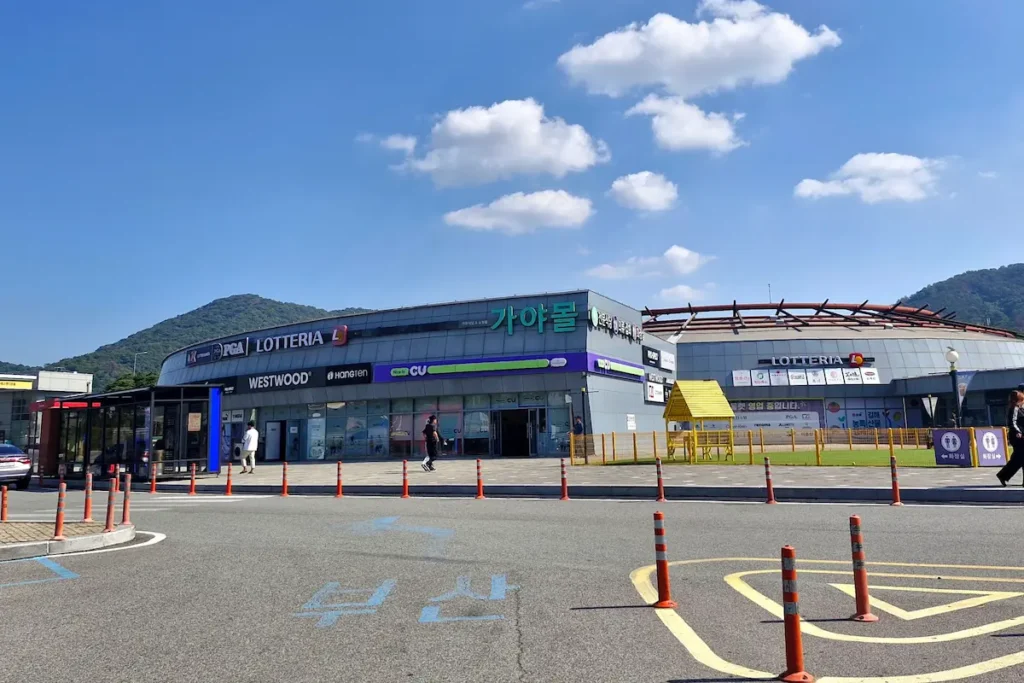
We stopped at Jinyeong Complex Rest Area (진영복합휴게소) in October 2026, and it was a good example of how much you can find during a simple stop on the highway.
For Koreans, stopping at a rest area for food or a snack is a normal part of a road trip. For a first-time visitor, though, the size, ordering system, and number of food choices can be a little surprising.
Quick Answer — What can you expect at a Korean highway rest stop?
GOOD TO KNOW
A Korean highway rest stop can include restrooms, a food court, convenience store, cafes, snack counters, and small retail shops. Larger rest areas may feel closer to a compact shopping and dining area than a simple roadside stop. Food can range from full Korean meals to quick snacks you can eat in the car.
What Is a Korean Highway Rest Stop?
Highway rest stops in Korea are designed for drivers and passengers to take a break during longer trips.
The basic idea is simple: park, use the restroom, get something to eat or drink, and continue your trip.
But many Korean rest stops offer much more than that.
At Jinyeong Complex Rest Area, we saw a convenience store, cafes and bakery counters, a food court, snack shops, outdoor stalls, and other retail spaces.
The building was large enough that it felt more like a small travel center than a simple rest stop.
The exact facilities vary from one location to another, so I would not expect every rest stop in Korea to look exactly the same.
Parking and Finding Your Way Around
The first thing you notice at a larger rest area is the amount of space.
There was a large parking area in front of the buildings, with different entrances leading toward food, shopping, and other facilities.
Once inside, signs helped direct visitors toward places such as the food court, convenience store, restrooms, and snack corner.
Even if you do not read much Korean, familiar restroom symbols and recognizable storefronts make the space fairly easy to understand.
For a first visit, I would take a moment to look at the signs before immediately walking into the first entrance you see.
Different sections of a large rest area may lead to different food or shopping areas.
The Food Court Can Be a Full Meal Stop
If you are hungry enough for a proper meal, the food court is one of the first places to look.
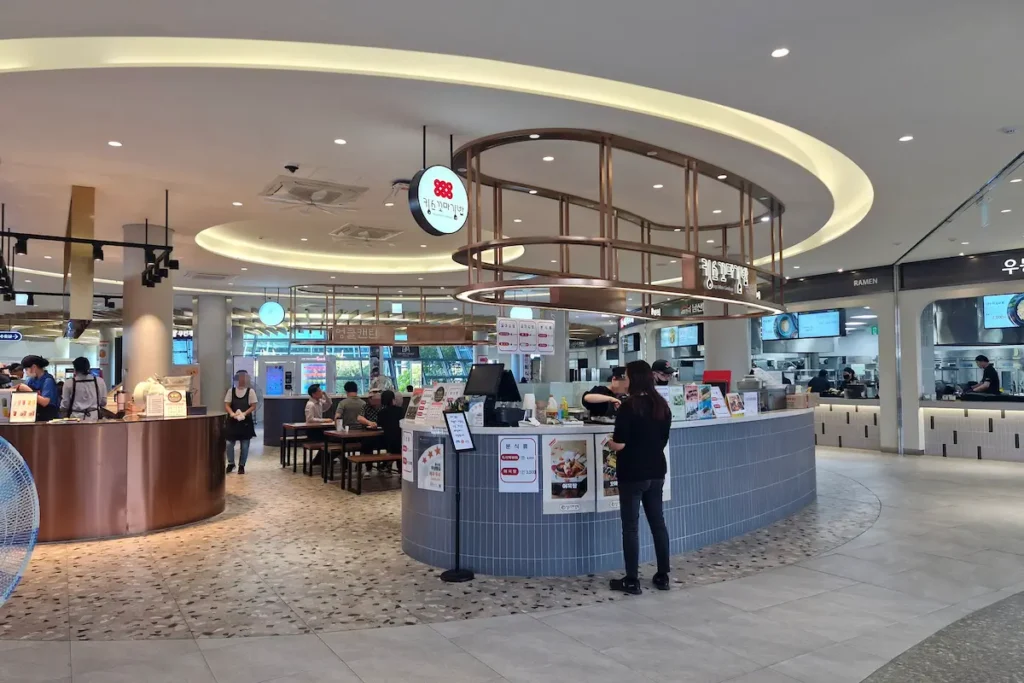
The food court at Jinyeong Complex Rest Area had a spacious seating area surrounded by different food counters.
This is important if you imagine a highway rest stop as a place that only sells coffee and packaged snacks.
In Korea, you can often stop during a road trip and sit down for an actual meal before getting back in the car.
What is available depends on the individual rest area, but food courts can offer a range of Korean meals and casual dishes.
If you are traveling with family, this also makes a rest stop useful when different people want different things.
You May Need to Order at a Kiosk
One thing international travelers should be prepared for is self-service ordering.
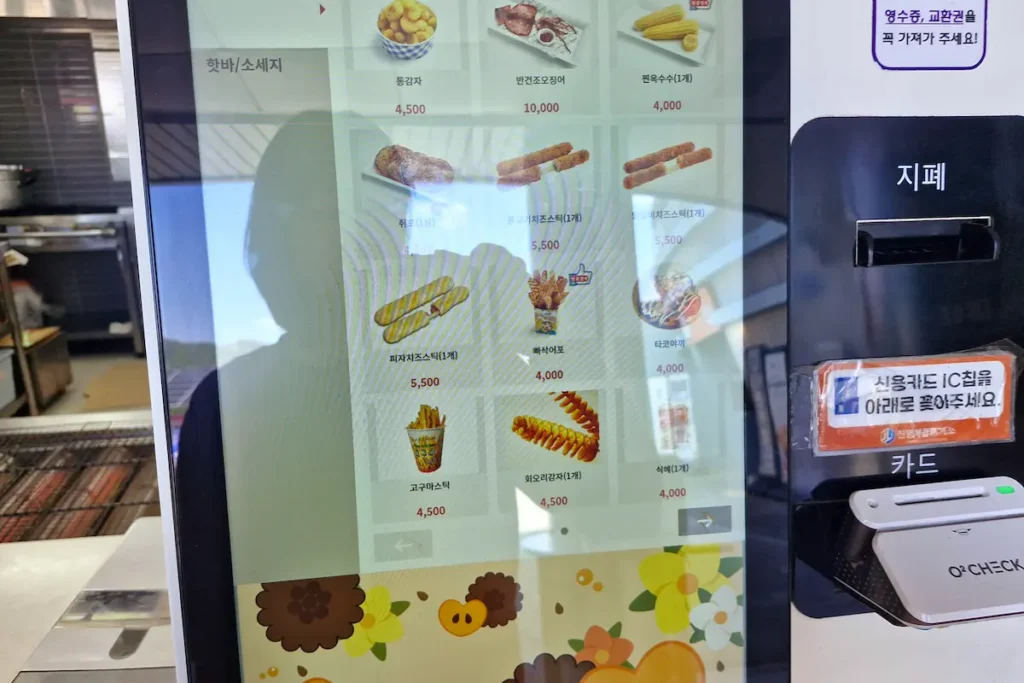
At the snack area we visited, the menu was displayed on a touchscreen kiosk.
The screen showed photos, Korean menu names, and prices. The machine also had card and cash payment areas.
The menu we saw included foods such as takoyaki, spiral potatoes, corn, dried squid, and several fried or grilled snacks.
A photo menu can make ordering easier even if you do not speak much Korean.
You can choose the item by looking at the picture rather than trying to pronounce every Korean name.
After ordering at the kiosk, we received a numbered slip. When our food was ready, we showed the slip at the counter and picked up the order.
However, kiosk systems vary, and not every machine will necessarily offer an English-language option.
Korea Byways Tip
If a kiosk feels confusing, look at the photos and prices first. At busy rest stops, watching how the person ahead of you orders can also make the process much easier.
Highway Rest Stop Snacks Are Part of the Experience
For me, one of the most interesting parts of a Korean highway rest stop is the snack selection.
You do not necessarily have to sit down for a full meal.
There are often foods designed to be eaten quickly before getting back on the road, and some are easy to carry back to the car.
At Jinyeong Complex Rest Area, we tried several snacks, including takoyaki, dakgangjeong, hot bar, and kkwabaegi.
The selection felt different from simply walking into a convenience store because many of the foods were prepared and served hot.
For snacks such as hot bars or hot dogs, there was a small refrigerated sauce station nearby. We could take the sauces ourselves and add as much as we wanted.
That is part of the fun of stopping at a highway rest area in Korea.
You may go in planning to use the restroom and come back to the car holding something you did not plan to buy.
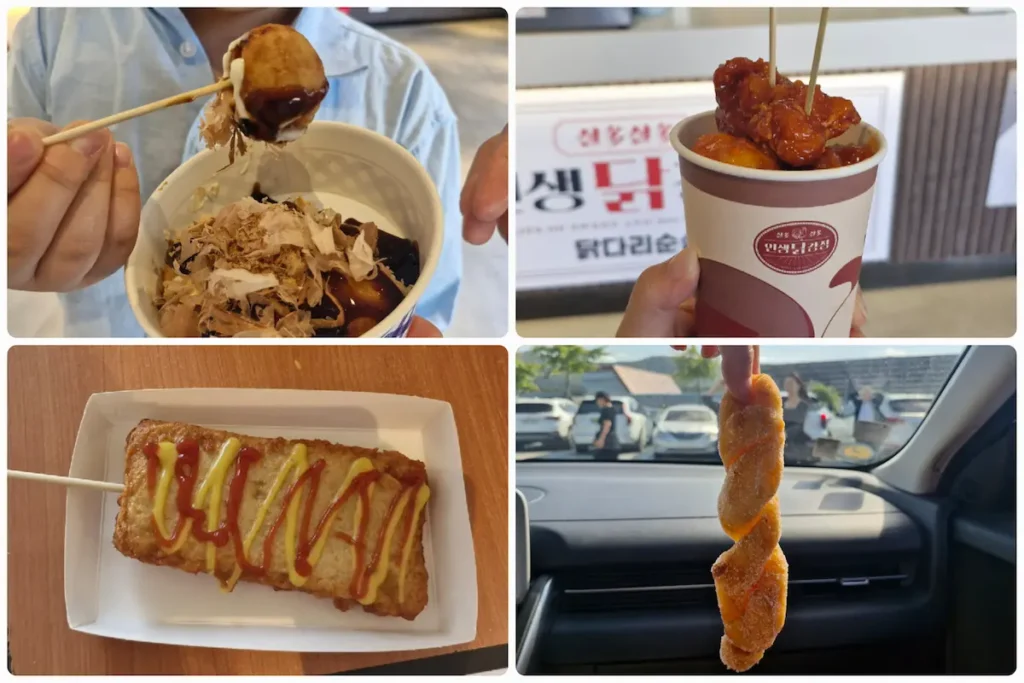
The exact snack selection changes from one rest area to another, which is one reason I would not make a strict list of foods that you “must” find.
Instead, I would look around first and see what that particular stop is serving.
Convenience Stores, Cafes and Bakeries
You do not have to eat from the food court or snack stalls.
At the rest area we visited, there were also familiar options such as a CU convenience store, coffee shops, and bakery-style counters.
This makes a rest stop useful even if you only want bottled water, coffee, a packaged snack, or something simple for the road.
There was also a Lotteria restaurant visible in the complex, along with other food and drink shops.
For an international traveler, familiar chains can sometimes make the stop feel easier, while the local snack stalls offer a chance to try something more specifically associated with a Korean road trip.
You May Find More Than Food
Another thing that stood out was the amount of shopping outside the main food areas.
We saw outdoor stalls selling clothing and various small goods.
This is not something I would consider essential to a highway stop, but it shows how some Korean rest areas function as small commercial spaces as well as places to rest.
If you have time, it can be interesting to walk around rather than going directly from the restroom back to the car.
Restrooms Are Easy to Find
Restrooms are one of the main reasons people stop, and at Jinyeong Complex Rest Area the signs clearly pointed toward them from the main entrance area.
For an international traveler, this is useful because you do not necessarily need to know the Korean word for restroom.
Look for the familiar male, female, and accessibility symbols.
At a large rest area, there may also be signs pointing toward different restroom locations, so checking the overhead signs can save some walking.
How Long Should You Stop?
There is no fixed amount of time you need.
If you only need the restroom and a drink, the stop can be short.
But if you want to eat a meal, look around the snack stalls, buy coffee, or browse the shops, it is easy to spend much longer than expected.
For our visit, the rest area felt like a natural break in the road trip rather than simply a place to rush through.
That is the way I would approach a Korean highway rest stop for the first time: give yourself enough time to look around.
Korea Byways Tip
If you are traveling with children or several people, decide where to meet before everyone separates for food, restrooms, or shopping. Larger rest areas can be more spread out than first-time visitors expect.
Are Korean Highway Rest Stops Worth Visiting?
If you are already driving on the highway, I think they are worth more than a rushed bathroom stop.
They offer a small look at everyday Korean road-trip culture.
You can see what people eat during long drives, how families take breaks, what kinds of snacks are popular, and how much can be packed into a single rest area.
They are not tourist attractions in the usual sense.
That is exactly why I find them interesting.
For travelers who want to see a little more of ordinary life in Korea, even a highway rest stop can become part of the trip.
Final Thoughts
Our stop at Jinyeong Complex Rest Area had a full food court, snack kiosks, convenience shopping, cafes, bakeries, and plenty of choices for either a quick break or a longer meal.
You do not need a complicated plan. Park, follow the signs, look around before ordering, and leave a little room for a highway snack you were not expecting to buy.
Sometimes the ordinary stops between destinations are part of what makes a road trip in Korea memorable.
Share this story
KOREAN TABLE
TRAVEL ESSENTIALS