How to Eat Sundubu Jjigae: A First-Timer’s Guide to Korean Soft Tofu Stew
Last updated: October 2026
Some Korean foods need a little explanation before the first bite.
Sundubu jjigae is one of them.
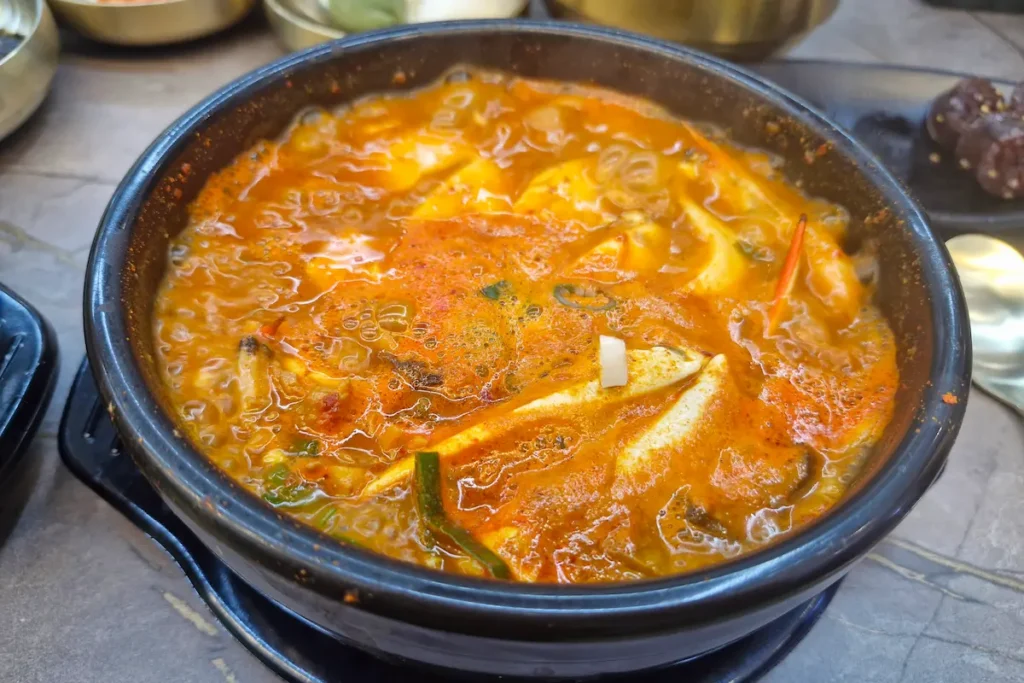
It arrives at the table in a black earthenware pot, often still bubbling hard enough that you may wonder whether you are supposed to wait.
Then there may be a raw egg.
Rice arrives on the side.
Several small dishes fill the rest of the table.
For Koreans, none of this feels unusual.
But if it is your first sundubu jjigae in Korea, a few questions are perfectly reasonable.
Here is what I would want to know before eating it for the first time.
Quick Answer: What Is Sundubu Jjigae?
GOOD TO KNOW
Sundubu jjigae (순두부찌개) is a Korean stew made with very soft, unpressed tofu, usually served hot in a spicy, savory broth.
A typical version may include ingredients such as:
- Soft tofu
- Seafood or meat
- Green onion
- Garlic
- Chili powder or chili oil
- Egg
Exact ingredients depend on the restaurant and the type you order.
It is usually served with rice and banchan, the small side dishes that accompany Korean meals.
My recommendation: If it is your first time, order a standard or seafood sundubu jjigae, keep the rice on the side, and give the stew a moment before taking the first spoonful.
It is much hotter than it looks.
1. What Makes Sundubu Different From Regular Tofu?
The word sundubu (순두부) refers to tofu with a very soft, delicate texture.
Regular tofu is usually drained and pressed until it becomes firmer.
Sundubu is much less pressed than regular tofu, leaving the curds soft, moist, and almost silky.
That texture is one of the main reasons the dish works so well.
The broth may be spicy and strong, but the tofu itself is mild.
You get a spoonful of hot, savory broth followed by tofu that almost falls apart before you have finished chewing it.
If you expect firm cubes of tofu, sundubu can be a surprise.
It is supposed to be this soft.
2. Why Does Sundubu Jjigae Arrive Bubbling?
Sundubu jjigae is often served in a ttukbaegi (뚝배기), a Korean earthenware pot used for hot soups and stews.
A ttukbaegi holds heat very well, so food can continue bubbling even after it has been brought to the table.
That is not just for presentation.
The pot helps keep the stew hot while you eat.
It also means one very practical thing for first-time visitors:
Do not touch the pot.
The black bowl may look like ordinary tableware, but it can stay extremely hot for quite a while.
Use the spoon for the food and leave the ttukbaegi where it is.
Korea Byways Tip
Do not feel that you have to eat the stew immediately because it has arrived.
Letting it bubble for a moment is fine.
Your rice and banchan are not going anywhere, and your first spoonful will still be very hot.
3. When Should You Add the Egg?
This is one of the things that can confuse first-time visitors.
Sometimes the egg is already in the stew.
Sometimes the restaurant gives you a raw egg separately.
And sometimes there is no egg at all.
All of those are normal.
At this meal, the egg came separately, so I cracked it directly into the stew while the broth was still bubbling.
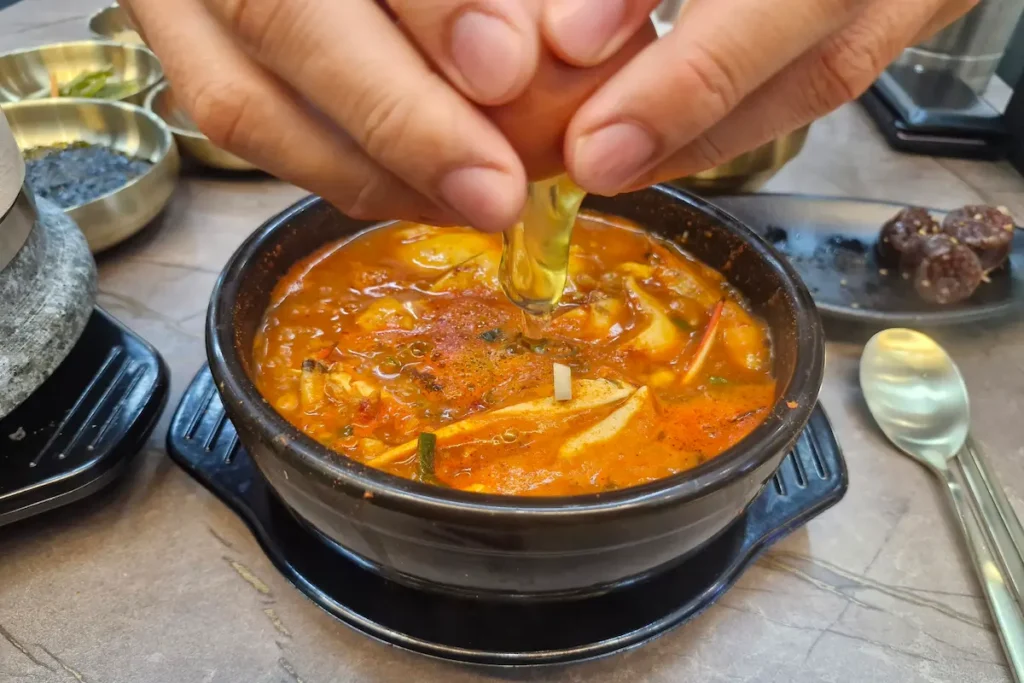
The remaining heat cooks it quickly.
What happens next depends on how you like your egg.
If you prefer a softer yolk, you can let it sit for a while without stirring too much.
If you want the egg more fully cooked and mixed through the broth, stir it in while the stew is still very hot.
There is no need to panic and crack the egg the second the pot reaches the table.
But if you are going to add it, doing so while the stew is still bubbling makes the most sense.
4. What Does Sundubu Jjigae Taste Like?
The most common red version is spicy, savory, and rich, but it is not simply a bowl of chili heat.
The tofu has very little aggressive flavor of its own.
Instead, it picks up the broth around it.
Seafood can add a briny depth.
Pork or beef can make the broth feel richer.
Kimchi versions can be sharper and more acidic.
And the egg can soften the overall flavor once it cooks into the stew.
The version I photographed was a seafood sundubu, with shrimp visible in the broth.
But the bite I like most is still the tofu itself.
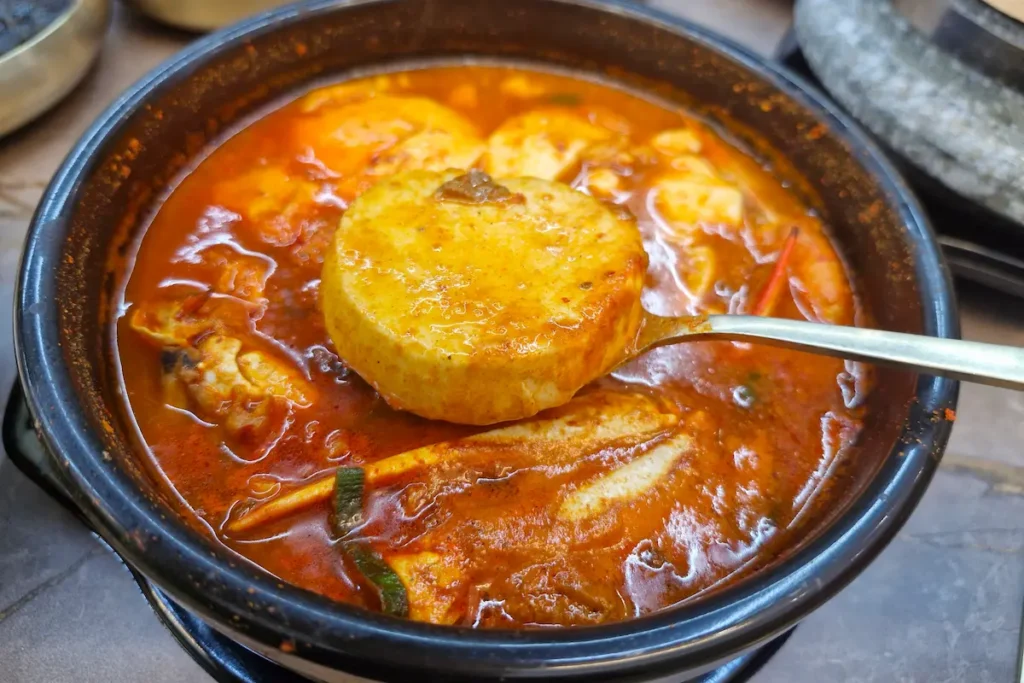
A large piece can look surprisingly solid on the spoon.
Then you eat it, and it is much softer than it appears.
That contrast between the spicy broth and delicate tofu is really the point of the dish.
5. What Types of Sundubu Jjigae Can You Order?
Sundubu restaurants often offer several versions rather than one standard bowl.
Depending on the restaurant, you may see options such as:
Seafood Sundubu
Often made with shellfish, shrimp, or other seafood.
This is a good first choice if you enjoy seafood.
Pork Sundubu
Usually richer and meatier.
Beef Sundubu
Another mild entry point if seafood is not your preference.
Kimchi Sundubu
A stronger, tangier version for people who already like kimchi.
Mushroom or Vegetable Sundubu
Available at some restaurants, although ingredients and broth bases vary, so vegetarian travelers should still ask whether the broth contains meat or seafood.
There is no need to search for the most unusual version on your first try.
A simple sundubu lets you understand the dish better.
6. Is Sundubu Jjigae Very Spicy?
Usually, there is some heat.
The red broth most travelers picture when they hear “sundubu jjigae” is normally made with Korean chili seasoning.
But the spice level varies a lot by restaurant.
There are also mild versions and even regional sundubu dishes with white broth rather than the familiar red one.
If you do not handle spicy food well, ask before ordering.
A useful phrase is:
덜 맵게 해주세요.
Deol maepge haejuseyo.
Please make it less spicy.
Not every restaurant can change the spice level because the broth may already be prepared.
So asking is useful.
Expecting every restaurant to adjust it is not.
7. How Do You Eat Sundubu Jjigae With Rice?
You do not need to dump the entire bowl of rice into the stew.
I usually keep them separate.
Take a spoonful of rice.
Then a little stew.
Or take a little sundubu and broth with a spoonful of rice.
There is no complicated technique.
At this meal, the sundubu came with hot rice and several banchan, including kimchi, seaweed, and other small side dishes.
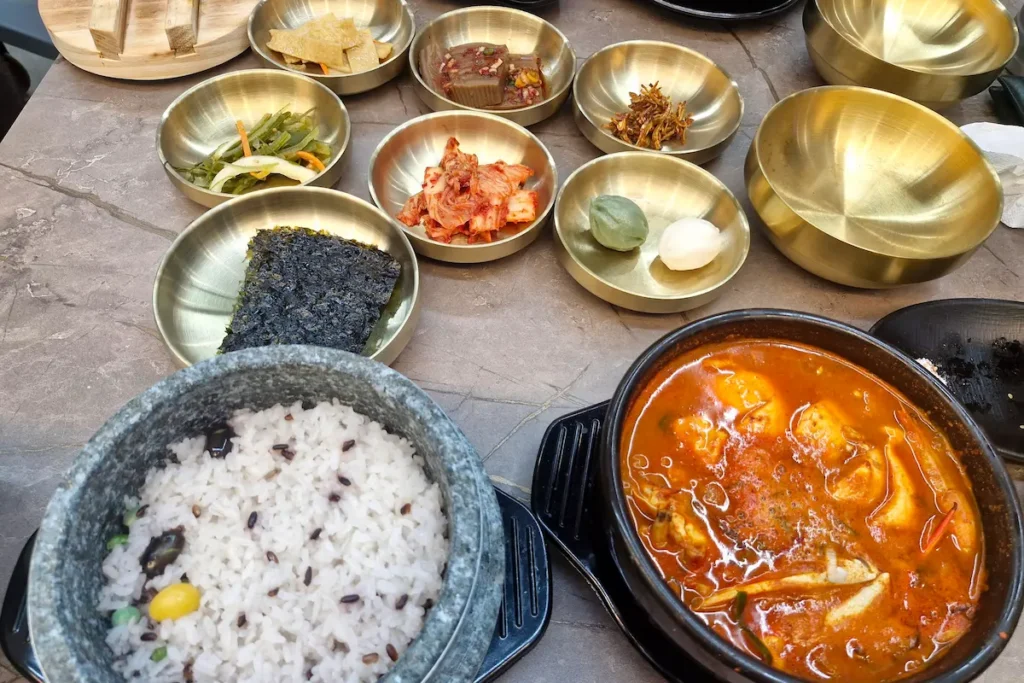
This is part of why sundubu jjigae feels like a complete Korean meal rather than just a bowl of soup.
You move between:
Stew → rice → banchan → stew again.
The rice also helps if the broth feels hotter or spicier than you expected.
Korea Byways Tip
You do not need to finish one thing before moving on to another.
Korean meals like this are designed to be eaten together.
Try different banchan between spoonfuls of sundubu.
8. What Are All the Small Dishes?
Those are banchan (반찬) — Korean side dishes.
Exactly what you receive depends on the restaurant.
Common examples include:
- Kimchi
- Seasoned vegetables
- Seaweed
- Fish cake
- Small anchovies
- Pickled vegetables
They are not appetizers that you have to finish before the main dish.
Eat them throughout the meal.
And if one side dish is unfamiliar, try a little.
Some of the most interesting parts of a Korean restaurant meal are often not the item you originally ordered.
9. Common First-Time Sundubu Mistakes to Avoid
Touching the ttukbaegi
It is cookware as well as serving ware.
Assume it is hot.
Taking a huge first spoonful
The stew can stay extremely hot.
Start small.
Thinking the egg must be added a certain way
If an egg is provided separately, add it while the stew is hot and cook it to the texture you prefer.
Pouring all the rice into the stew immediately
You can.
But you do not need to.
Keeping the rice separate lets you control how much broth you eat with each bite.
Assuming every sundubu is equally spicy
Restaurant recipes vary.
Ask if spice is a concern.
Expecting the same ingredients everywhere
Seafood, pork, beef, kimchi, mushrooms, and other variations are all possible.
Check the menu before ordering.
10. What I Recommend for Your First Sundubu Jjigae
Keep the first bowl simple.
I would:
1. Choose seafood, pork, or the restaurant’s basic sundubu.
2. Ask about the spice level if you are sensitive to heat.
3. Let the bubbling pot settle for a moment.
4. Add the egg if one is served separately.
5. Keep the rice beside the stew.
6. Try the tofu, broth, rice, and banchan together.
And do not rush.
Sundubu jjigae stays hot for a long time.
That is part of the meal.
Final Thoughts
Sundubu jjigae does not look subtle when it arrives.
The broth is red.
The pot is bubbling.
There may be a raw egg waiting beside it.
But the ingredient at the center of the dish is one of the softest foods on the Korean table.
That contrast is what makes it work.
The broth brings the heat and flavor.
The sundubu keeps everything gentle.
The rice and banchan turn it into a complete meal.
For a first-time visitor to Korea, it is also a good introduction to the way many everyday Korean meals work.
One hot main dish.
Rice on the side.
Several small things to share or try between bites.
And no need to make eating it more complicated than it is.
Let the pot cool a little, take a spoonful of tofu, and start there.
Share this story
KOREAN TABLE
TRAVEL ESSENTIALS