Sancheong Day Trip: Suseonsa Temple, Donguibogam Village & Local Food
Travel date: September 12, 2026
Sancheong is not the kind of place most international travelers put on their first Korea itinerary.
That is part of why I like it.
It is a small rural county in Gyeongsangnam-do, surrounded by mountains and closely connected with Jirisan. Its population was only about 33,000 in early 2025.
I visited again on September 12, this time for a simple Sancheong day trip with my family.
There was no packed sightseeing schedule.
We walked around a quiet temple, ate at a restaurant I have returned to more times than I can count, and spent the afternoon at
Donguibogam Village in the mountains.
It was exactly the kind of day I think Sancheong does well.
Quick Answer: Is Sancheong Worth Visiting?
GOOD TO KNOW
Sancheong is a good choice if you want a slower, more local side of Korea with mountains, traditional culture, and places that are easy to enjoy as a family.
For this day trip, I would combine:
1. Suseonsa Temple
2. Lunch in Sancheong-eup
3. Donguibogam Village
4. Mureung Bridge
5. The family-friendly outdoor areas inside Donguibogam Village
A car makes this particular itinerary much easier.
My recommendation: Do not try to turn Sancheong into a checklist. It works better as a relaxed day with time to walk, look around, and stop when something catches your attention.
1. Start at Suseonsa Temple
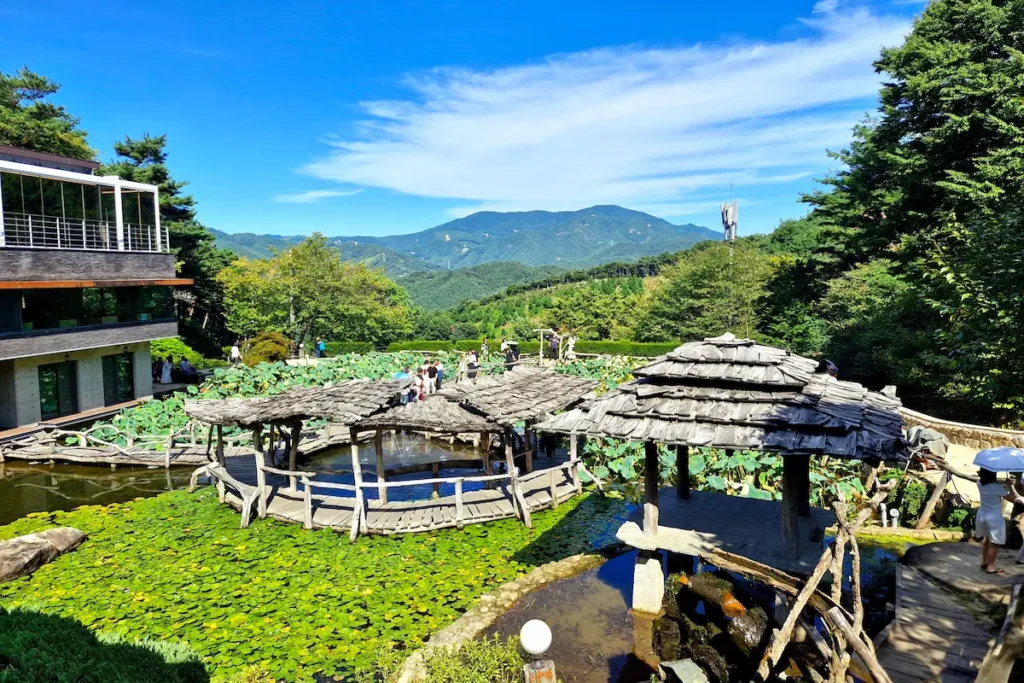
Suseonsa (수선사) sits below Ungseokbong Peak on the edge of Jirisan.
It is not a huge historic temple complex filled with famous national treasures.
What makes it memorable is the setting.
Sancheong tourism describes Suseonsa as a place where traditional culture, nature, and a more contemporary sensibility come together, and it is especially known for its pond and garden. Admission is currently listed as free.
That description matched what I felt there.
The pond was the first thing that caught my attention.
Suseonsa is known for lotus flowers, but when we visited in September, none were in bloom.
I did not mind.
The pond was still almost completely covered in broad lotus leaves, wooden paths curved over the water, and a waterwheel turned slowly nearby.
With the mountains behind it, the entire scene felt unmistakably Korean without feeling staged for tourists.
2. Suseonsa Was Better With a Child Than I Expected
Temples can sometimes be difficult with children.
Adults may want to look quietly at buildings and gardens while children are finished after five minutes.
Suseonsa was different for us.
There were frogs around the pond and plenty of aquatic plants and small things to look for, so my child had something to discover while I enjoyed the garden.
That made the visit much easier.
There is also a café where you can stop for tea or coffee, and I found a gallery-like space displaying works made from wood.
Suseonsa also operates a temple-stay program for visitors who want a longer experience.
Korea Byways Tip
Do not visit Suseonsa only because you have seen photographs of its lotus flowers.
The lotus season is beautiful, but I enjoyed the temple even without a single flower in bloom.
The pond, wooden paths, waterwheel, trees, and mountains were enough.
3. Lunch at Daepyo Jjajang (대표짜장)
After Suseonsa, we stopped for lunch at a Korean-Chinese restaurant called Daepyo Jjajang (대표짜장).
This is not a restaurant I happened to find on this trip.
I go there almost every time I visit Sancheong.
I have probably eaten there more than ten times, which is more useful than any one-time restaurant review I could give.
And I still go back.
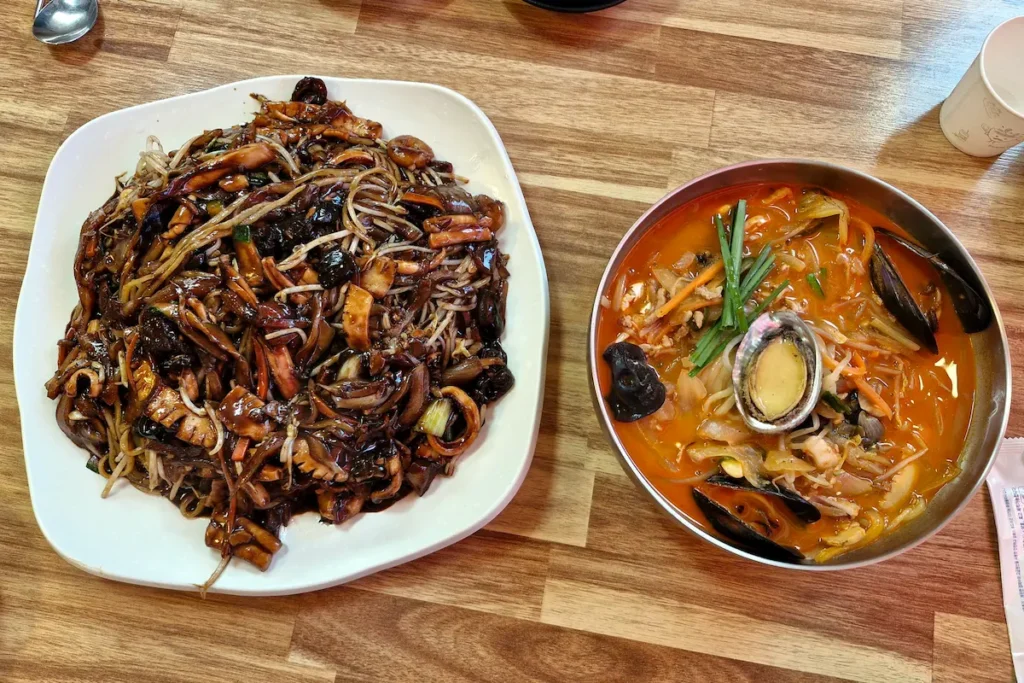
On this visit, we ordered haemul jaengban jjajang and jjampong.
Jaengban jjajang is a large platter of noodles coated in black-bean sauce, and this version comes loaded with seafood.
The jjampong is a spicy seafood noodle soup.
For me, the broth is the reason to order it.
I also really like the tangsuyuk and fried dumplings here.
So if you are traveling with several people, I would order a few things and share.
This is also one of those details I like about small-town travel in Korea.
Sancheong is tiny, but popular local restaurants can still have a line at lunchtime.
My Recommendation
If I were bringing someone to Sancheong for the first time, this is where I would take them for lunch.
Not because it is traditional Sancheong food.
I would take them because it is somewhere I actually return to.
That distinction matters to me.
4. What Is Donguibogam Village?
After lunch, we headed to Donguibogam Village (동의보감촌).
Before visiting, it helps to know what Donguibogam actually is.
Donguibogam is a medical encyclopedia compiled in Korea in 1613 and edited by physician Heo Jun under royal instruction.
It brought together medical knowledge and treatment practices of its time, including ideas related to preventive medicine and public health. UNESCO added Donguibogam to its Memory of the World Register in 2009.
One useful distinction:
Donguibogam is UNESCO documentary heritage — part of the Memory of the World Register — rather than a UNESCO World Heritage Site.
Donguibogam Village was created around Sancheong’s connection with traditional medicine, medicinal herbs, and the Jirisan region. Today the large mountain site includes exhibition facilities, herbal-themed areas, walking routes, family attractions, forests, and outdoor spaces.
I would not think of it as one museum.
It feels more like a large mountain park built around the idea of traditional Korean medicine and wellness.
5. Mureung Bridge Was My Favorite View
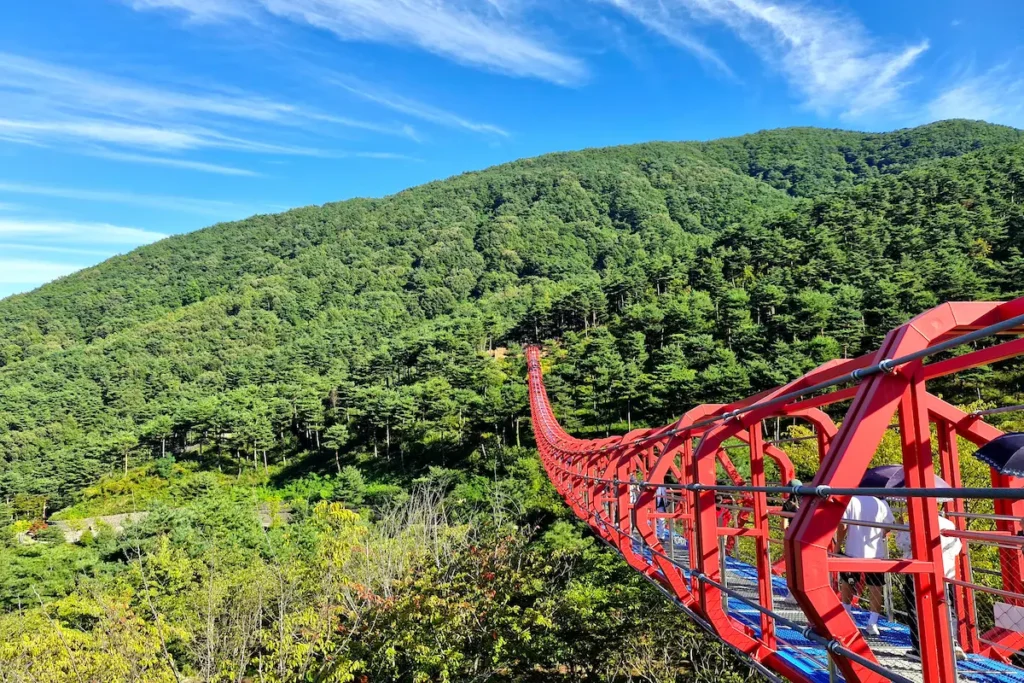
The most dramatic part of our visit was Mureung Bridge (무릉교).
It connects walking routes across the valley and gives you wide views over the surrounding mountains.
The bridge is 211 meters long, about 1.8 meters wide, and reaches roughly 35 meters above the valley at its highest point.
Those numbers sound fairly ordinary until you are actually standing on it.
It moves.
Not wildly, but enough.
The combination of the height, the open valley below, and the movement of the bridge made it much more exciting than I expected.
And the scenery was excellent.
Green mountains filled the view in almost every direction.
I would cross it again.
But if you really dislike heights or suspension bridges, this may not be the relaxing part of Donguibogam Village for you.
6. Donguibogam Village Is Surprisingly Good With Children
One thing I did not expect was how much there was for children to look at.
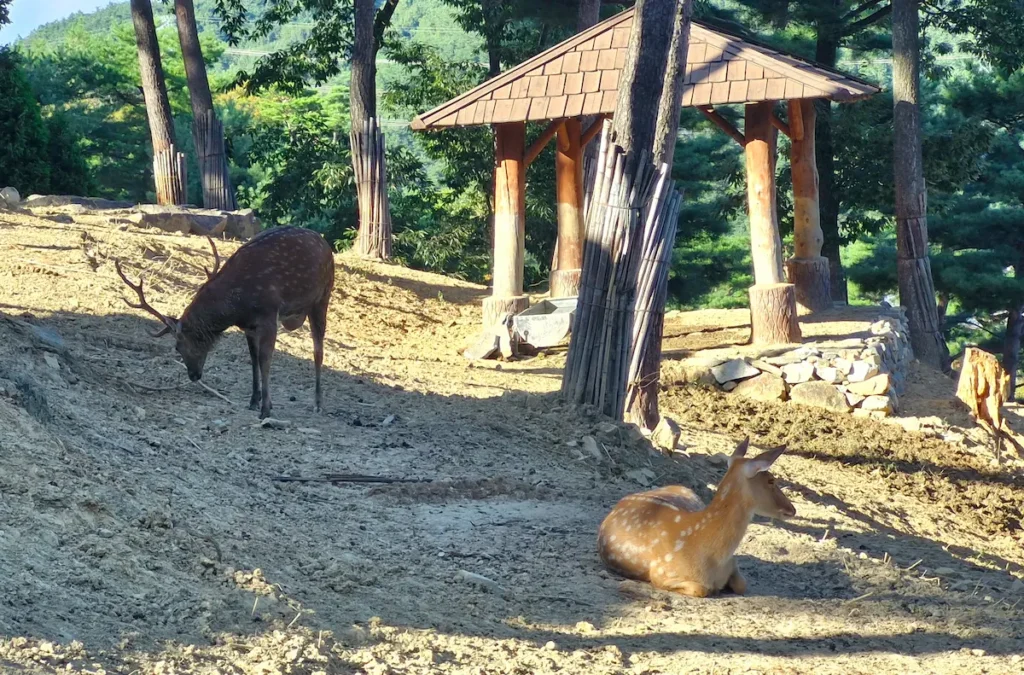
We saw deer living in a large ecological area, and there were other outdoor spaces where children could move around rather than spend the whole afternoon inside exhibitions.
The official site lists a 7,500-square-meter deer ecology area, a Jirisan Asiatic black bear ecology learning area, and an outdoor traditional-medicine theme park designed to be accessible and interesting for children and teenagers.
We also found a children’s forest play area.
That mattered on a family trip.
A place can be culturally interesting for adults, but if a child spends the entire visit hearing “don’t touch that” and “be quiet,” nobody has a particularly good afternoon.
Here, there was enough space and variety to avoid that.
Korea Byways Tip
Donguibogam Village is much larger than it looks on a simple map.
Do not arrive with only thirty minutes before closing and expect to see everything.
Choose a few areas that interest you and leave room to walk.
7. The Story Behind Donguibogam Is Worth Knowing
I think this is the part that deserves more attention from international visitors.
Without context, Donguibogam Village can simply look like a mountain attraction with museums, herbs, bridges, and family activities.
But the book behind its name is much more significant.
What interests me most is that Donguibogam was not simply a medical reference book. It also reflected ideas about preventive medicine and public health that were remarkably systematic for its time.
You do not need to be particularly interested in medicine to find that interesting.
For me, it is another example of how much Korean history exists outside the palaces and major tourist sites most visitors see first.
I would like to see Donguibogam become better known internationally.
8. What About the Sancheong Herbal Medicine Festival?
If you visit in autumn, check the dates for the Sancheong Herbal Medicine Festival.
The 2026 festival runs from October 2 to October 11 at Donguibogam Village. The official program includes exhibitions, performances, herbal experiences, children’s activities, food, and other events.
I went to the festival last year.
What I remember most is that there was a lot to see and eat, so the atmosphere is very different from an ordinary visit to Donguibogam Village.
If your priority is quiet mountain scenery, I would come on a normal day.
If you want more activity, food, and special programs, festival season is the better choice.
For future years: check the official festival dates before planning around it, because they change annually.
9. How I Would Plan This Sancheong Day Trip
For a relaxed day, I would do it in this order:
Morning — Suseonsa Temple
Walk around the pond and garden without rushing.
If you want, stop for a drink at the café.
Lunch — Sancheong-eup
Eat before heading into Donguibogam Village.
Afternoon — Donguibogam Village
Start with the areas that matter most to you.
For us, that meant Mureung Bridge, the outdoor spaces, and the animal areas.
If museums and traditional medicine are your priority, give those more time instead.
10. Practical Information
Suseonsa Temple
Address:
102-23 Ungseokbong-ro 154beon-gil, Sancheong-eup, Sancheong-gun, Gyeongsangnam-do
VisitKorea currently lists general visiting hours as 09:00–18:00, admission as free, and parking as available. Because this is an operating temple, it is still worth checking before a long drive if visiting hours are important to your plans.
Donguibogam Village
Address:
45-6 Donguibogam-ro 555beon-gil, Geumseo-myeon, Sancheong-gun, Gyeongsangnam-do
The overall Donguibogam Village is listed as open year-round. The Expo Theme Hall and Korean Medicine Museum currently operate 09:00–18:00 and normally close on Mondays, January 1, and the day of Seollal and Chuseok.
Individual exhibitions, experiences, and facilities can follow different schedules, so check current information if one particular activity is important to you.
How Long Would I Allow?
For this exact itinerary, I would treat Sancheong as a full-day trip.
You could rush through it faster.
I would not.
11. Is Sancheong Good for Families?
For us, yes.
Suseonsa had frogs, water, plants, and paths that kept my child interested.
Donguibogam Village had much more open space than a typical museum visit, plus deer, play areas, and plenty of room to walk.
The main thing to keep in mind is distance.
There is a lot of walking, and Donguibogam Village is spread over a mountain landscape.
Comfortable shoes are more useful here than trying to look dressed for the perfect travel photo.
Final Thoughts
Sancheong is quiet.
That may be its biggest strength.
It does not have the dense list of famous attractions you find in Seoul or Busan.
Instead, you get a temple garden at the foot of a mountain, a restaurant filled with local customers, a bridge suspended over a green valley, deer in the forest, and a place built around one of Korea’s important medical texts.
None of those things alone needs to be spectacular.
Together, they make a very good day.
When I think about the kind of Korea I want to show through Korea Byways, Sancheong is exactly the sort of place I have in mind.
It is local.
It is easy to overlook.
And it gives you a reason to slow down.
Share this story
EXPLORE MORE
TRAVEL ESSENTIALS