What Is Budae Jjigae? Korea’s Army Stew, Explained
Last updated: September 2026
There are some Korean foods that make perfect sense the moment you see them.
Budae jjigae may not be one of them.
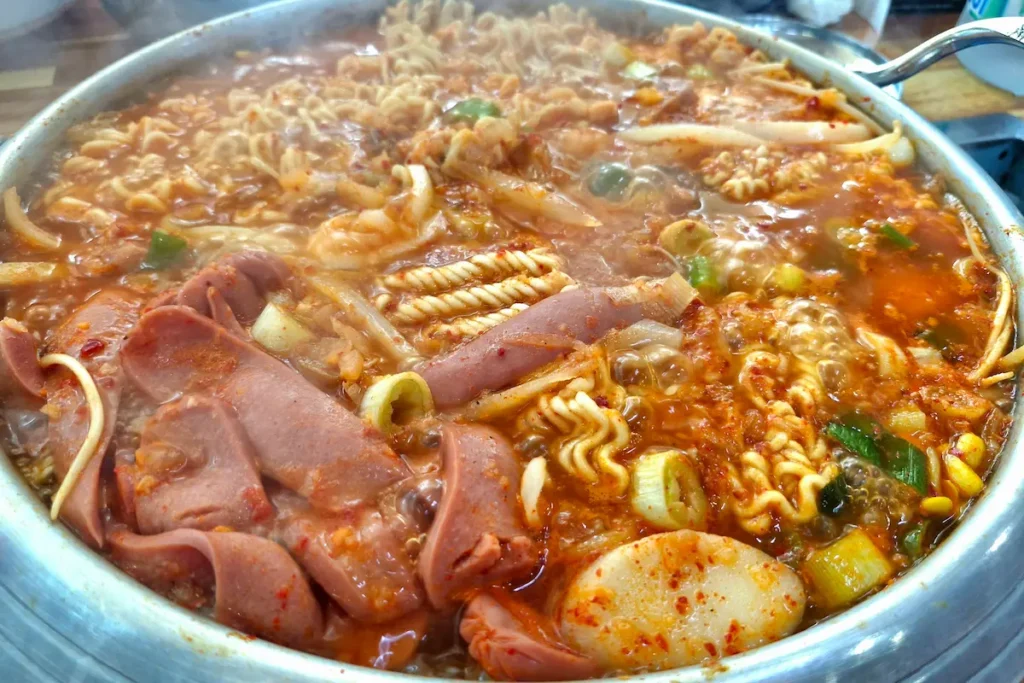
A bubbling pot can contain kimchi, sausage, Spam, baked beans, tofu, green onions, cheese, and even instant noodles — ingredients that do not necessarily sound like they belong together.
But somehow, they do.
For many Koreans, budae jjigae is not an unusual novelty. It is warm, spicy, comforting food that is especially satisfying when shared around a table.
It is also a dish with a history that says a lot about modern Korea.
And for me, there is one rule:
Budae jjigae needs ramyeon.
Quick Answer: What Is Budae Jjigae?
GOOD TO KNOW
Budae jjigae (부대찌개) is a Korean spicy stew made with Korean ingredients such as kimchi and gochujang together with processed meats such as ham and sausage.
The name literally combines:
budae (부대) = military unit
jjigae (찌개) = Korean stew
It developed in the years following the Korean War, when foods associated with U.S. military bases — including sausages, ham and canned goods — began to be combined with Korean ingredients and cooking methods.
Today, it is a completely established Korean dish rather than simply a historical curiosity.
My recommendation: If you try budae jjigae, order rice and add ramyeon sari. For me, the noodles are essential.
1. Where Did Budae Jjigae Come From?
The history behind budae jjigae is important because the dish was born during a difficult period.
After the Korean War, food was scarce and American military bases were established in several areas of Korea.
Ingredients such as sausage, ham, bacon and canned beans from around the bases began to be combined with foods Koreans already ate, including kimchi, vegetables, chili paste and chili powder.
Over time, those combinations developed into what we now know as budae jjigae.
The exact birthplace of budae jjigae is difficult to establish, but the dish became especially closely associated with Uijeongbu.
Uijeongbu, north of Seoul, became particularly associated with the dish because of the large U.S. military presence nearby. By the 1960s, restaurants specializing in budae jjigae were developing around the city, and today Uijeongbu even has a dedicated Budaejjigae Street.
There is an interesting detail that is easy to misunderstand:
Despite the English nickname “army stew,” budae jjigae developed as a Korean dish in communities around U.S. military bases rather than as a U.S. military menu item.
Rather, it was a Korean dish that developed in communities around military bases using ingredients that became available there.
That distinction matters.
The name “army stew” can sound playful today, but its beginnings are tied to a period of hardship and food scarcity.
2. So What Actually Goes Into Budae Jjigae?
There is no single fixed recipe.
Every restaurant has its own version, but you may find ingredients such as:
- Kimchi
- Ham
- Sausage
- Spam or other canned ham
- Tofu
- Green onions
- Mushrooms
- Rice cakes
- Baked beans
- Cheese
- Glass noodles
- Ramyeon noodles
The broth is usually spicy and savory, often built around kimchi, chili powder or gochujang.
VisitKorea describes the dish as essentially a meeting of Korean kimchi-jjigae-style cooking with Western processed meats.
And that is exactly what makes it interesting.
A slice of Spam tastes completely different after simmering in a spicy kimchi broth.
3. Spam Has a Different Image in Korea
This is one cultural difference that can surprise visitors.
I know that Spam does not have the most glamorous reputation in some countries.
In Korea, however, it occupies a very different place.
Spam gift sets remain a familiar sight during major holidays such as Seollal and Chuseok, even today.
So yes — in Korea, giving someone a box filled with Spam can genuinely be a holiday gift.
I personally understand both sides of the argument.
I know processed meat is not something I should eat every day.
But I also really like Spam.
There is something about a slice of Spam fried until the edges are slightly browned and eaten with a bowl of steaming white rice that I find very hard to resist.
I almost always keep a can or two at home.
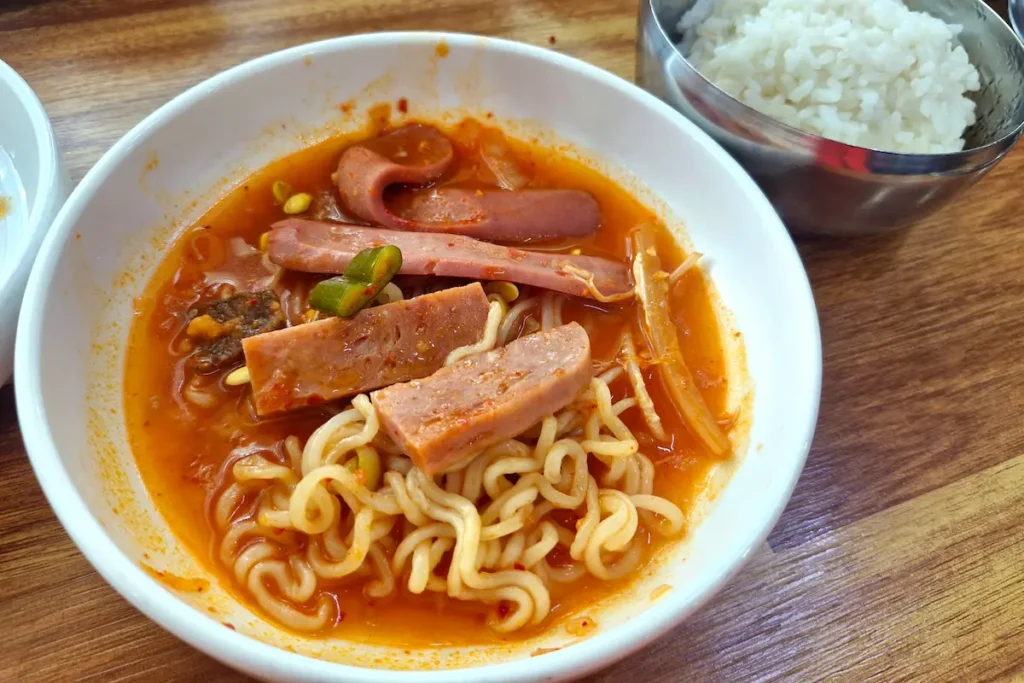
And in budae jjigae, Spam makes even more sense. Its salty richness mixes into the spicy broth and becomes part of the flavor of the entire pot.
4. What Does Budae Jjigae Taste Like?
The first flavor is usually spicy and savory.
But it is not simply another spicy Korean stew.
The processed meats add saltiness and richness, the kimchi contributes acidity, and the vegetables and broth balance everything together.
Depending on the restaurant, cheese or baked beans can add an extra creamy or slightly sweet note.
The longer the pot simmers, the more the flavors come together.
That is part of the fun of eating it.
Budae jjigae usually arrives at the table in a large pot, and everyone eats from it together while it continues bubbling.
5. For Me, Ramyeon Sari Is Essential
I do not consider my budae jjigae complete without ramyeon sari (라면사리).
Ramyeon sari is basically a block of instant noodles added to a dish without the instant soup seasoning packet.
You let the noodles cook directly in the budae jjigae broth.
And this is where I have a very specific preference.
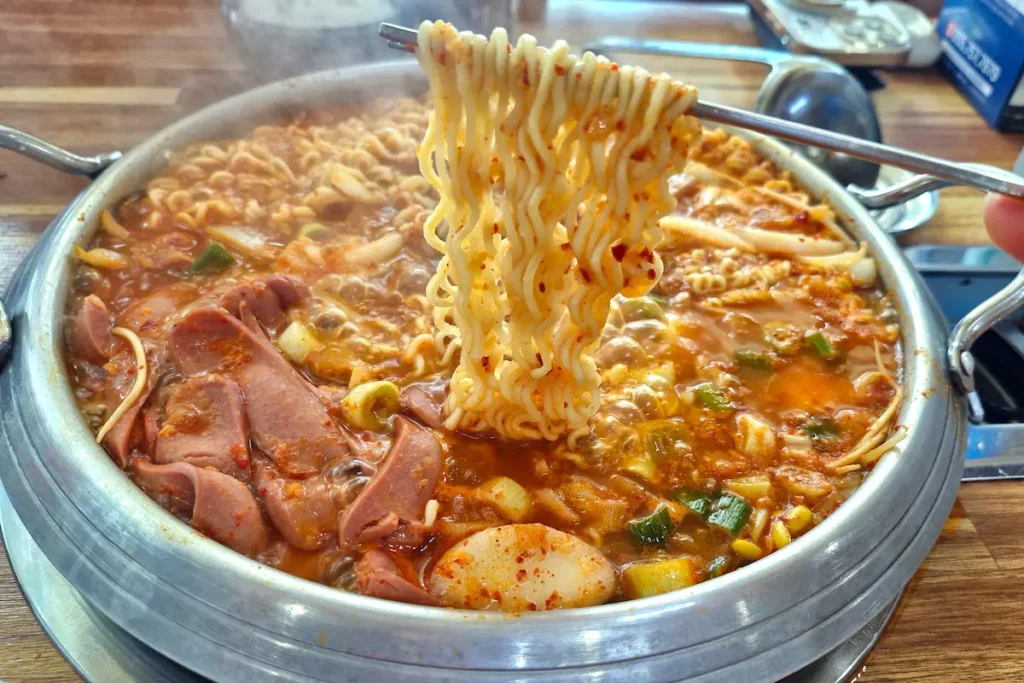
I like to wait until the stew is almost ready, add the ramyeon, and then start taking the noodles out fairly quickly.
I do not want them sitting in the pot until they become very soft.
I like them kkodeul-kkodeul (꼬들꼬들) — slightly firm and springy.
The noodles absorb the spicy, savory broth while still keeping that chewy texture.
For me, that is one of the best bites in the entire meal.
Korea Byways Tip
If you also prefer firmer noodles, do not wait until everyone has finished the other ingredients before adding the ramyeon.
Once the noodles go into a boiling pot, they cook quickly.
6. How Do Koreans Usually Eat Budae Jjigae?
Budae jjigae is usually a shared meal.
A large pot sits in the middle of the table and continues cooking while everyone eats.
White rice is almost always a good idea.
You can take a little broth, sausage, kimchi and tofu and eat them with rice, then move on to the noodles when they are ready.
You may also see restaurants offering additional sari, or add-ons, such as:
- Ramyeon
- Rice cake
- Extra sausage
- Extra ham
- Cheese
- Dumplings
The exact choices depend on the restaurant.
If you are eating with several people, adding one or two extras can make the meal even better.
7. The Most Unusual Budae Jjigae I’ve Ever Had
I have eaten budae jjigae many times, but one restaurant in Daejeon gave me an experience I had never seen before.
The restaurant is called:
급이다른 부대찌개
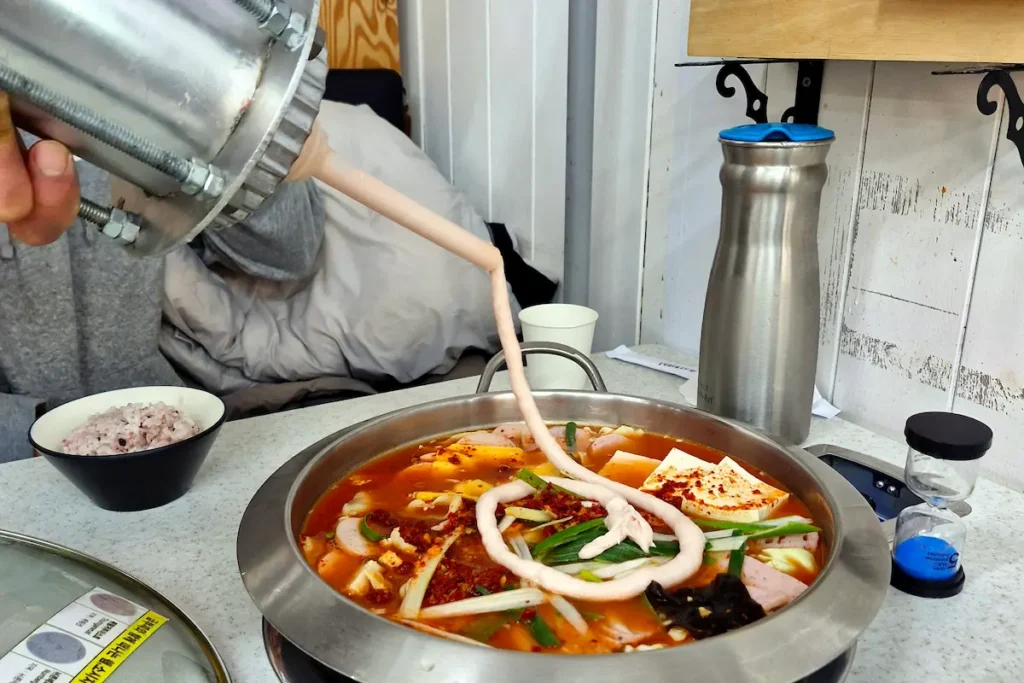
Its signature dish uses several types of house-made ham, but the memorable part comes when fresh ham is added to the pot.
The owner brought out a novelty device styled after a Vulcan cannon and used it to extrude fresh house-made ham directly into the bubbling stew.
Yes, really.
It was part food and part performance.
But what surprised me most was that the unusual presentation was not the only reason to remember the meal.
The house-made ham itself was genuinely fresh and delicious.
The restaurant currently describes its signature “Vulcan fresh-ham budae jjigae” as containing several types of handmade ham, and its current listing places it in Jijeok-dong, Yuseong-gu, Daejeon.
Where I Tried It
Restaurant: 급이다른부대찌개 (Geubi Dareun Budae Jjigae)
Location: Daejeon, South Korea
Address: 8-14 Eungubiseo-ro 23beon-gil, Yuseong-gu, Daejeon
Known for: House-made ham and its unusual Vulcan-style fresh-ham budae jjigae experience
Opening hours and waiting conditions can change, so check the restaurant’s current information before visiting.
If you are already visiting Daejeon for a Seongsimdang bakery pilgrimage, I think this is the kind of meal that can make a fun addition to the trip.
I would not go only for the cannon-shaped gimmick.
I would go because I actually liked the ham.
8. Is Budae Jjigae Very Spicy?
Usually, it has some heat.
But the spice level can vary considerably by restaurant.
If you already enjoy kimchi jjigae or other red Korean stews, budae jjigae will probably feel familiar.
What makes it different is the richness from the sausage and ham.
For travelers who are very sensitive to spicy food, it is worth asking whether the restaurant can make it less spicy, although not every restaurant will adjust the broth.
9. Who Should Try Budae Jjigae?
I especially recommend it if you like:
- Kimchi
- Spicy soups and stews
- Sausage or ham
- Instant noodles
- Hearty comfort food
- Sharing food from one pot
It is also an interesting dish for travelers who want to understand Korean food beyond bulgogi, bibimbap and Korean barbecue.
Budae jjigae is not a traditional dish with centuries of history.
Its story belongs to modern Korea.
And that is exactly why I think it is worth knowing.
10. What I Recommend for Your First Budae Jjigae
For a first visit, I would keep it simple.
Order the standard budae jjigae and rice.
Then add:
Ramyeon sari.
If there are two or more of you, you can also add extra sausage or another topping you are curious about.
Let the pot simmer until the ingredients are fully cooked, but keep an eye on the noodles once the ramyeon goes in.
And do not be afraid of the Spam.
It belongs there.
Final Thoughts
Budae jjigae may look like an unlikely combination of ingredients.
Kimchi, Spam, sausage and instant noodles do not immediately sound like a dish with a coherent identity.
But once everything simmers together, it makes sense.
For me, budae jjigae is warming, satisfying comfort food — especially when the weather is cool and there is a bowl of white rice beside it.
It also tells an unusually complicated Korean story.
A dish that began during a period of scarcity has become something people intentionally seek out, customize with extra toppings, and share around a bubbling pot.
And although I have eaten many versions over the years, I still have the same priorities:
Plenty of ham, a bowl of hot rice, and ramyeon noodles that are still just a little bit firm.
Share this story
EXPLORE MORE
TRAVEL ESSENTIALS